Canada’s Top Mineral & Metal Exports by Country (2024)

Canada’s Top Mineral & Metal Exports by Country (2024)

Canada's Mining Exports by Country 2024

Canada is an export-based economy, where the mining sector plays a crucial role. With our vast mineral and metal reserves ranging from gold and diamonds to nickel and uranium, Canada supplies a variety of ores, concentrates, and fabricated mining products to almost every country worldwide [1] – although a large majority of these exports go to a select few trade partners.

In 2024, Canada exported over $153 billion of minerals and metals, accounting for more than one-fifth (21%) of all Canadian merchandise exports that year. That means one in every five export dollars earned by Canadians came from mining – a cornerstone of Canada’s economic strength. Of those exports, $125 billion (82%) were metals, $18 billion (12%) were non-metals, and another $10.2 billion (7%) were coal and coke [1].

Below, we take a look at where Canada’s mineral and metal exports went around the world in 2024, along with more important information on our job-creating, prosperity-generating mining industry!
Canadian Mining Exports: Quick Facts

  • Total mineral & metal exports (2024): $153 billion
  • Share of all Canadian merchandise exports: 21%
  • Top markets: U.S. (52%), U.K. (15%), China (6%)
  • Top products by value: gold, iron & steel, aluminum, copper, iron ore
  • Fastest growing export (by value): uranium (+53%)

Where Canada’s Mining Exports Went in 2024

Canada's Mining Exports by Country 2024 - Mineral and Metal Exports

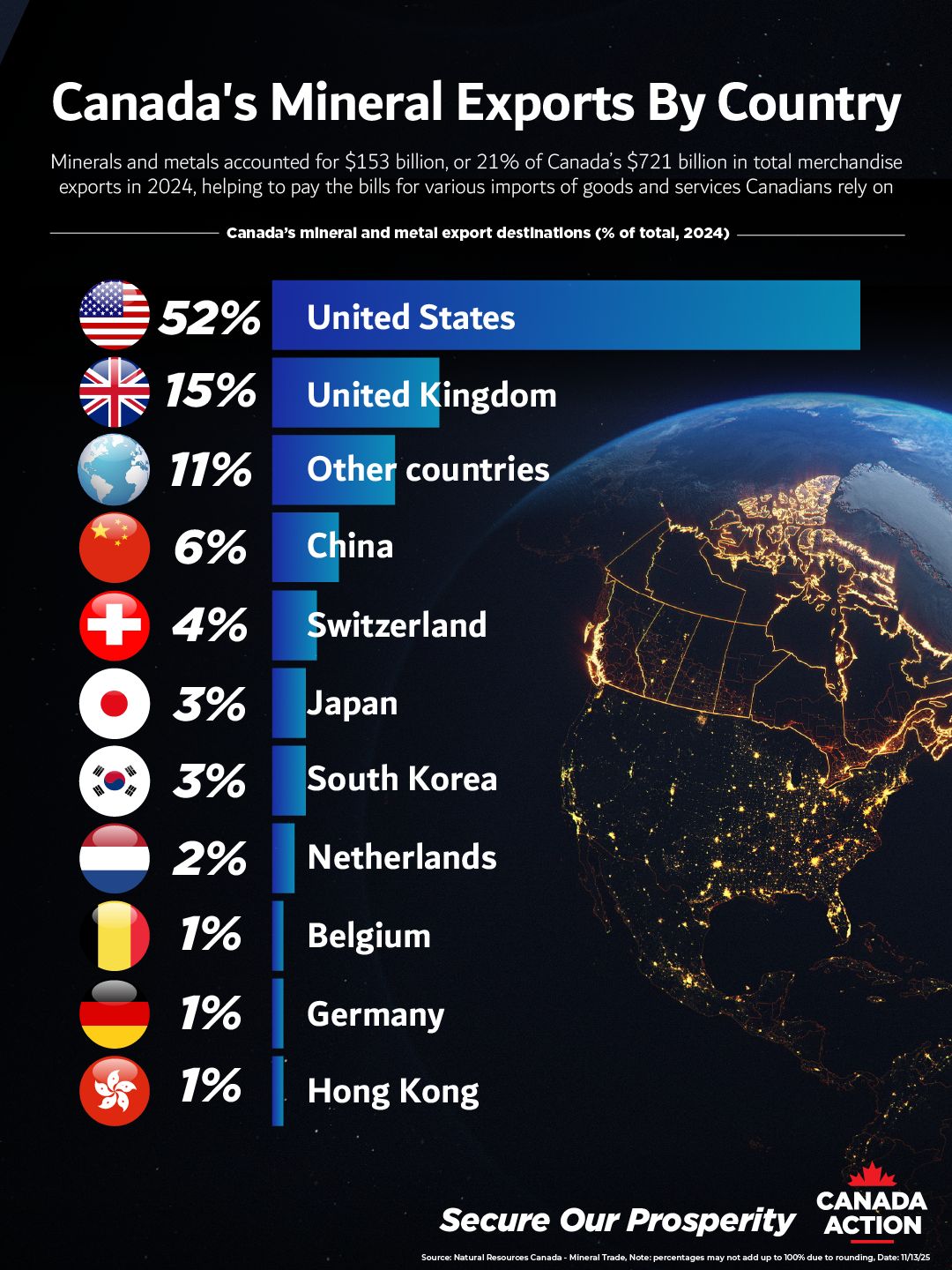
In 2024, the United States remained our dominant mining export market, accounting for just over half of Canada’s mineral and metal exports. The United Kingdom jumped into second place, driven almost entirely by surging gold exports, while China remained a significant but smaller buyer. Beyond these top markets, Canada still has major room to grow new trade opportunities in Asia and Europe.

52% - 🇺🇸 United States

  • Canada–U.S. mining trade: $142 billion in 2024 (–3% YoY)
  • Canada’s exports to U.S.: $79.6 billion (–5% YoY)
  • Top exports: iron & steel (23%), aluminum (20%), gold (12%), copper (8%), potash (5%)
  • Takeaway: The U.S. is still our most important partner, but small declines show why we can’t rely on one market alone.

15% - 🇬🇧 United Kingdom

  • Trade value: $24.1 billion (+126% YoY)
  • Canada’s exports to U.K.: $22.7 billion (+141% YoY)
  • Top exports: gold (96%), uranium (2%), iron ore (1%)
  • Takeaway: The U.K. has become a major gold customer, highlighting how global demand for reliable gold supplies benefits Canada.

6% - 🇬🇧 China

  • Trade: $24.4 billion (+1% YoY)
  • Canada’s exports to China: $9.5 billion (–9% YoY)
  • Top exports: coal (29%), iron ore (26%), copper (21%), gold (5%), potash (5%)
  • Takeaway: China is an important market, particularly for bulk commodities like coal and iron ore, but overall exports have dipped, underlining the importance of broadening our customer base.

4% - 🇨🇭 Switzerland
3% - 🇯🇵 Japan
3% - 🇰🇷 South Korea
2% - 🇳🇱 Netherlands
1% - 🇧🇪 Belgium
1% - 🇩🇪 Germany
1% - 🇭🇰 Hong Kong
11% - 🌏Other Countries


Canada’s Top Mining Export Products (2024)

Canada’s top five most valuable mineral and metal exports in 2024 included gold ($40.2 billion), iron and steel ($20.6 billion), aluminum ($17.4 billion), copper ($10.7 billion), and iron ore ($8.8 billion) [1].

Commodity Exports ($ millions CAD, 2024)
Metals 125,045
Gold 40,231
Iron and Steel 20,593
Aluminum 17,396
Copper 10,660
Iron Ore 8,767
Uranium 4,958
Nickel 4,616
Zinc 1,956
Silver 1,718
Platinum Group Metals 1,413
Other Metals 12,737
Non-Metals 18,045
Potash 7,954
Diamonds 1,519
Sulphur 1,268
Sulphuric Compounds 788
Other Non-Metals 6,516
Coal 10,175
Total Exports 153,272 or ~$153 billion

Which of Canada’s Mining Exports are Growing the Fastest?

The total value of Canada’s metal exports increased 8% in 2024 year-over-year, totalling approximately $125 billion. Below are various mining product exports and their relative growth or decrease in export value year-over-year [1].

Commodity Export Growth 2024 (Value)
Uranium +53%
Gold +33%
Copper +15%
Silver +14%
Aluminum +3%
Platinum Group Metals -45%
Nickel -21%
Iron and Steel -6%
Zinc -5%
Iron Ore -2%

What is the Difference Between Metals and Minerals?

  • Metals:

Substances—often elements on the periodic table—which are known for being strong, shiny, and good at conducting heat and electricity. Examples important to Canada include aluminum, copper, nickel, and gold.

  • Minerals:

Naturally occurring, inorganic solids with a specific chemical composition and crystalline structure. Many minerals contain metals that can be extracted, like the nickel and copper ores that are critically important to Canada’s mining sector.

Why Diversifying Our Mining Export Markets Matters

Recent trade challenges with the United States show why Canada can’t afford to put all our eggs in one basket. The U.S. will remain our most important partner, especially for critical minerals used in defence and those in emerging technologies, but Canadian workers and businesses need the ability to reach customers in Europe, Asia, and beyond when disputes arise.

To do that, Canada must invest in new ports, rail lines, roads, and other infrastructure so our minerals and metals can reliably reach global markets. The same infrastructure will also help get our energy, agriculture, and forestry products to customers around the world.

Unlocking Canada’s Mining Opportunity

A recent report by the Mining Association of British Columbia estimates $984 billion in long-term economic activity from just 27 mining projects in that province alone. That’s hundreds of thousands of potential jobs and billions in government revenues.

Now multiply that mining potential across Canada. If we speed up permitting and approvals while maintaining strong regulatory standards, Canadians can unlock more of our mineral wealth, support our allies with reliable supplies, and keep those jobs and investments here at home instead of losing them to less democratic, less reliable countries abroad.

Canadians have a choice: we can lead the world in critical minerals and metals, or watch this immense economic opportunity pass us by. Supporting policies that enable resource development, timely project approvals, and new trade infrastructure means more jobs, more prosperity, and a stronger Canada for generations to come.

SOURCES:

1 - https://natural-resources.canada.ca/maps-tools-publications/publications/mineral-trade

2 - https://www.canada.ca/en/campaign/critical-minerals-in-canada/canadas-critical-minerals-strategy.html