

https://youtu.be/ceJSWrBx0c4

As an export-based economy, Canada must act now to expedite new resource development and transportation infrastructure including pipelines, power lines, ports, railways, and roads, which will help us diversify our trade relationships and secure our economic future.
Natural resources account for roughly 50% of Canada’s total merchandise exports every year [1], while exports account for approximately 20% of our national economy [2]. Our exports help us pay for everything we import; they help make life more affordable by supporting the value of our Canadian dollar and improving our purchasing power.
Currently, 75% of Canada’s exports are destined for U.S. markets [5], making our economy highly reliant on a single trading partner. By fostering new trading partnerships with other nations abroad, we can reduce this dependency and insulate our economy from tariffs.
Canadians can choose to secure our long-term prosperity and maximize the value of our natural resources – or, we can let ourselves be heavily reliant on a single trading partner.
The time to act and take control of our economic independence is now.

A strong resources sector means more job opportunities, economic growth, and prosperity for all Canadians. Accounting for:
… our energy, forestry, mining, and agriculture sectors generate tens of billions of dollars to support critical social programs such as healthcare, education, and emergency services [4].
Supporting our job-creating, prosperity-generating resource industries can help Canada address current economic challenges, including weak business investment, low productivity, regulatory uncertainty, and tariffs [1].
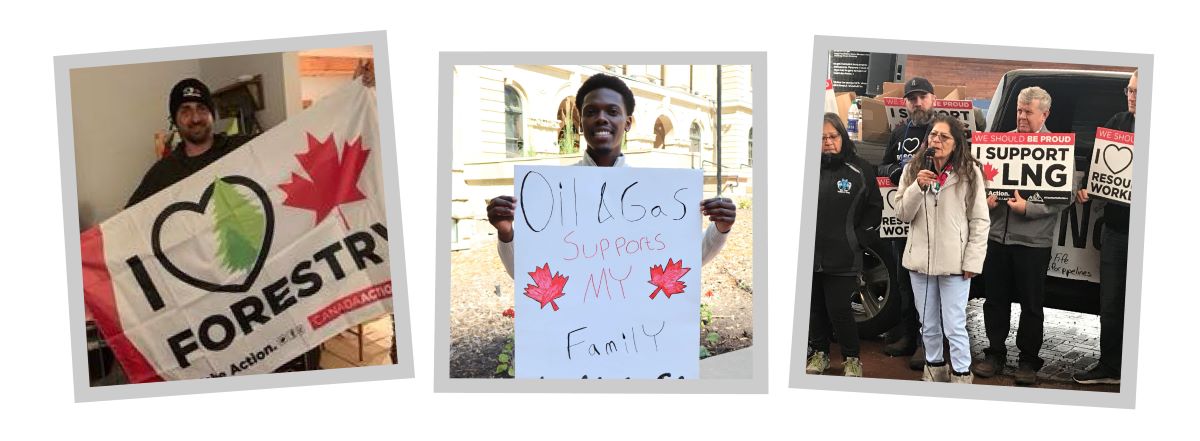
Canadians can no longer afford to miss out on economy-boosting opportunities to develop our vast wealth of energy, forestry, mining, and agricultural resources. That means streamlining our regulatory systems and prioritizing natural resource projects to restore investor confidence and spur job creation in our country.
Overburdening and unnecessary regulations like the oil and gas emissions cap and the West Coast tanker ban – while global oil and gas demand is growing to new record highs – do nothing to promote Canadian competitiveness and prosperity in an ever-changing global market.
For example, several now-cancelled LNG facilities in Canada, such as the $36 billion Pacific Northwest LNG project, underwent gruelling regulatory processes with exceptionally high costs and no assurances from Canadian governments—all of which led to their eventual demise [6]. All this, despite many countries including Germany, Japan, and South Korea that have said they want or would support Canadian-made LNG.

Mark Carney, Prime Minister of Canada
"It's time to build new trade and energy corridors working in partnership with the provinces, territories, and Indigenous peoples. It's time to build hundreds of thousands of not just good jobs, but good careers in the skilled trades. It's time to build Canada into an energy superpower in both clean and conventional energy." [Global News]
Tim Hodgson, Canada's Minister of Energy & Natural Resources
"Canada's natural resources are not only a cornerstone of our national identity - they are the foundation of our economy. Protecting and modernizing our resource industries in the face of tariffs and global uncertainty is critical to safeguarding Canadian jobs and communities and ensuring a prosperous and strong future." [Government of Canada]
David Eby, Premier of British Columbia
“If you’re not buying oil and gas from Canada and British Columbia, the alternative is Venezuela.” [CPAC]
Doug Ford, Premier of Ontario
"It's time for us to build cross-Canada infrastructure within our borders so we can protect our energy security, find new markets for Canadian energy and resources and create new jobs and opportunities for Canadian workers." [Government of Ontario]
Danielle Smith, Premier of Alberta
“The federal government must immediately drop the anti-resource development laws holding our economy back and work at all haste to approve multiple pipelines, rail expansions, and transmission lines going west, east, and north to diversify and grow our expert markets around the world.” [Western Standard]
François Legault, Premier of Quebec
“What do we do anyway? If there is or not some tariffs? We need to have diversification of market. So it includes working better with other provinces, but also with Europe, with other countries than U.S.” [CTV]
Tim Houston, Premier of Nova Scotia
“A project like the Energy East could move resources from the west to the east and then onto Europe. It will open up incredible opportunities for our country.” [Global News]
Wab Kinew, Premier of Manitoba
“Well, yesterday we had this amazing announcement. Some $80 million being invested into the port of Churchill and the rail line that serves it, so that our mining products, our AG products, can get to the EU, can get to Brazil, we can help resupply Nunavut. This is a really smart investment… it's also about diversifying the markets that we can ship our goods to from here in Manitoba.” [CPAC]
Scott Moe, Premier of Saskatchewan
“We all know the story behind Northern Gateway and Energy East. And, you know, those are two projects that I think we as Canadians should certainly become advocates for sooner rather than later. So that we are energy independent not only on a continental basis, but also ensuring that we have access to other markets…” [CPAC]
Canadians can no longer afford to miss out on natural resource development. With $670 billion in cancelled or suspended resource projects since 2015 and facing new challenges such as U.S. tariffs, we must act now to diversify our markets and secure a strong economic future for our families. and country.
Global demand for food, wood, minerals, metals, oil, and natural gas is growing. We must take this opportunity to empower Canadian and Indigenous communities by developing our vast natural resource wealth.
It’s time to build Canada up.


SOURCES:
[1] - Canadian Chamber of Commerce. (2024 September). Canada’s Natural Wealth. [PDF]. Retrieved from https://businessdatalab.ca/wp-content/uploads/2024/09/Canadas_Natural_Wealth.pdf
[2] - Scotiabank. (2025 January). Canada-US Trade; Getting Up To Speed. [PDF]. Retrieved from https://www.scotiabank.com/ca/en/about/economics/economics-publications/post.other-publications.canada-and-us-economics-.canada-and-us-decks.trade-stats--january-31--2025-.html
[3] - Macdonald Laurier Institute. (2024 May). Canada’s Resource Sector. [PDF]. Retrieved from https://macdonaldlaurier.ca/wp-content/uploads/2024/04/20240402_Canada-Golden-Goose-CrossMintz_PAPER-v9-FINAL.pdf
[4] - Natural Resources. (n.d.). 10 Key Facts on Canada’s Natural Resources - 2023. [web page]. Retrieved from https://natural-resources.canada.ca/science-data/science-research/data-analysis/10-key-facts-canada-s-natural-resources-2023
[5] - BBC. (2025 February). Canada leaders take push against tariffs to White House. [web page]. Retrieved from https://www.bbc.com/news/articles/cj91xrp4zyjo
[6] - Financial Post. (2017 July). Pacific Northwest LNG, 2012-2017: How to kill an LNG project in Canada. [web page]. Retrieved from: https://financialpost.com/commodities/energy/pacific-northwest-lng-2012-2017-how-to-kill-an-lng-project-in-canada