
Canada is a vast, resource-rich nation with huge potential to provide energy security to Canadians and the world. From our immense crude oil and natural gas reserves to our rich uranium deposits and leadership in nuclear electricity technology, we have the resources to be the energy supplier the world needs.
As global energy consumption is expected to continue growing through 2050 [1][2], Canadian families have an immense opportunity to benefit by supplying even more Canadian-made energy to domestic and international markets – building a stronger, more prosperous economy here at home in the process.
Top Articles on Canadian Energy Security
20 Times Other Countries Said They Want Canadian-Made LNG Since 2022 72% of Canadians Support Oil & Gas to Strengthen Energy Security: POLL Canada Needs to Focus on Building Energy Self-Reliance, Before It’s Too Late It’s Time to Walk the Talk on Building Canada’s Energy Future Energy in Canada: 35 Facts & Statistics Getting New Energy Infrastructure Built is Key to Canada’s Long-Term Success How Much Oil Does Canada Import? Too Much! See all of Canada Action’s “energy security” related blogs today!
Canadian Energy Security: Quick Facts
- Despite being the third-largest global oil producer and fourth-largest oil exporter, Canada imports around 500,000 barrels of oil annually, mainly into the eastern provinces, valued at roughly $20 billion [4]
- Despite being the fifth-largest natural gas producer and sixth-largest natural gas exporter, Canada imports more than 2.5 billion cubic feet (bcf) of natural gas per day, mainly into Ontario, Quebec, and New Brunswick [5]
- Over the past several years, U.S. state governments have attempted to shut down Line 5, a critical pipeline that connects Western Canadian oil and natural gas liquids to eastern Canadian markets [5]
- The Line 5 pipeline moves more than 50% of the oil consumed in Ontario, and two-thirds of the oil used in Quebec [5]
- Canada is projected to double its electricity demand over the next 25 years [3]
Canada’s Energy Security Vulnerabilities
When it comes to energy security in Canada, many Canadians are unaware of our significant vulnerabilities.
Recent trade challenges with the U.S. – our largest trading partner, which accounts for the vast majority of Canada's imports and exports – have highlighted that relying on integrated cross-border pipelines to ship Western oil to Eastern provinces could pose an energy security risk.
Meanwhile, Canada’s eastern refineries continue to import around half a million barrels a day of oil from places like Nigeria, Saudi Arabia, and the U.S. – despite our country having the world’s third-largest proven oil reserves. Ontario, Quebec, and New Brunswick also import significant amounts of natural gas.
With the emergence of electric vehicles, heat pumps, and artificial intelligence (AI), Canada’s electricity demand is expected to double over the next 25 years [3]. Our communities and businesses will need new power sources, while distribution networks must be expanded and modernized to meet our growing electricity needs.
Power grids across the country, with a few exceptions, remain relatively disconnected from one another. Significant work is required to create a fully integrated power grid that spans all jurisdictions, providing Canadians with a secure electricity supply for generations to come.
How to Ensure Canada is Energy Secure
Canada needs new energy infrastructure, including pipelines, power plants, and power lines, to ensure our energy security for decades to come – and to connect to global markets, supporting a strong economy here at home.
We need the capacity to ship more of our oil and natural gas from our coastal regions to Asia and Europe. We need our provinces and territories connected via interprovincial transmission lines, allowing hydropower generation in Manitoba or Quebec, for example, to be shipped to places like Prince Edward Island and the Yukon.
Electricity demand in North America is poised to surge, with Canadian demand projected to double or more over the next few decades. This will require a significant build-out of new power generation and transmission infrastructure to keep our homes, businesses, and industries running.
Canada also needs pragmatic policies that balance our energy security needs with other government initiatives. As an export-based economy that relies heavily on natural resources as a foundation of our success, we must take an “all-of-the-above” approach and support all forms of energy – wind, solar, oil, natural gas, hydro, geothermal, nuclear, etc. – ensuring a strong, prosperous, and energy-secure future for our families.
Canada’s Energy Security Opportunity: Quick Facts
- Global liquefied natural gas (LNG) demand is projected to double by 2050; Canada has an immense opportunity to benefit by providing LNG to the world [2]
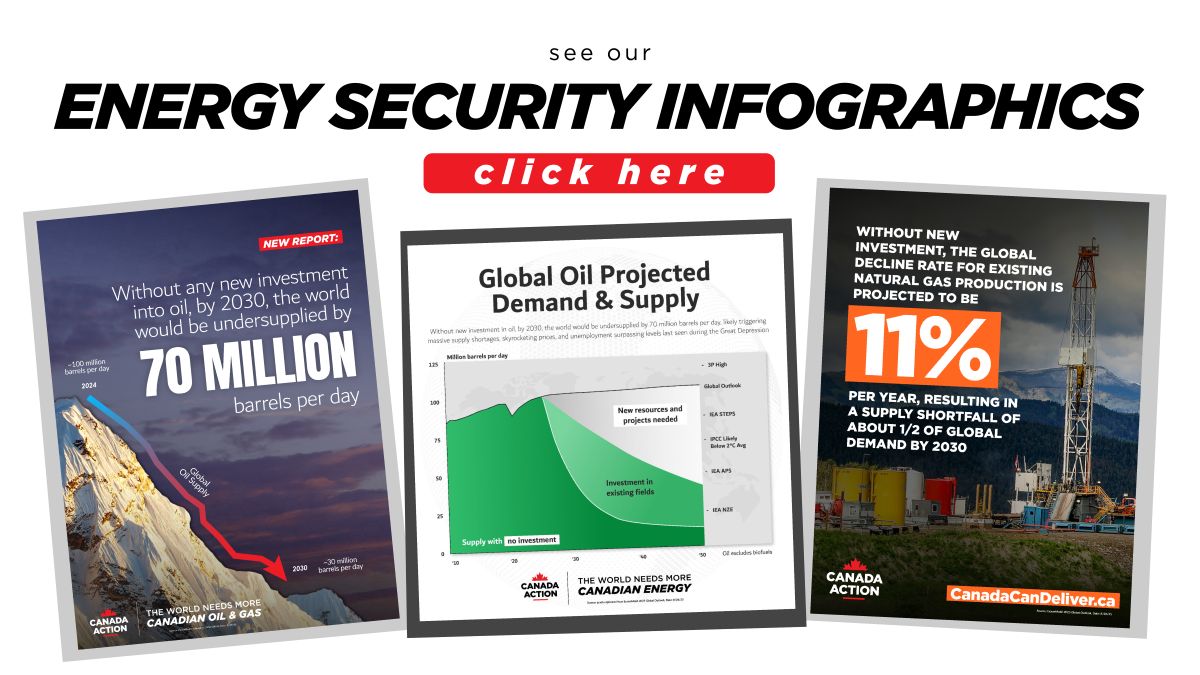
- Global oil demand is projected to reach 105 million barrels per day (bpd) by 2050, up from 100 million bpd in 2024; meanwhile, up to 15% of current supply – about 15 million bpd of production – must be replaced every year to meet global demand, another immense opportunity for Canadians [2]
- With North American electricity demand set to expand rapidly over the next several years, Canada has vast generating potential and capabilities – including hydro, nuclear, natural gas, wind, solar, and other energy sources – that can help supplement power for emerging artificial intelligence (AI), economic electrification, and more
- New energy technologies such as hydrogen are also immense opportunities for Canadians to benefit, by stepping up to provide domestic and international markets with a source of democratic, reliable supply
Canada’s Global Energy Security Opportunity
Today, roughly half the world’s population – approximately 4 billion people – lack adequate access to the reliable energy needed for housing, employment, infrastructure, and other essential human needs [2]. As global standards of living improve, the world will require more energy, not less, presenting a significant opportunity for Canada to step up and become the go-to supplier for nations worldwide.
Abroad, increasing geopolitical tensions have led to a restructuring of our global energy systems. Since 2022, for example, several nations have approached Canada, asking us to step up as a reliable source of natural gas, hydrogen, minerals, and other critical resources, as they seek to diversify away from unreliable suppliers. In fact, countries such as Malaysia, Japan, and South Korea are investing in Canadian upstream natural gas facilities to make our natural gas a key component of their energy supply [4].
Meanwhile, global demand for oil and gas is expected to continue growing for decades to come, with oil consumption projected to reach 105 million barrels per day by 2050 [2]. To meet this demand, the world will need to invest in new sources of supply. Canada’s vast, democratic reserves make us the perfect candidate to fill this gap.
The World Needs More Canadian Energy
Canada has a generational opportunity to become a global leader in energy security, providing a reliable and democratic source of supply to our trade partners. By developing our abundant natural resource wealth and building new infrastructure, we can create countless jobs for Canadians, generate billions in economic activity, provide steady revenue streams for our governments, and ensure a prosperous future for our country.
By supporting energy security here at home as well as our growing role as a democratic, reliable supplier to the world, we are supporting Canadian families and communities from coast to coast.
Energy Security in Canada: FAQ
Energy security means having reliable, affordable energy available when Canadians need it, so our economy can grow, businesses can operate, industries can produce, and the government is efficiently funded through royalties and taxes from said economic activity.
Our electricity and fuel resources are critical to everything we do. Ensuring Canadians have uninterrupted access to energy is not only crucial to our economy but also to the security and safety of all our families and communities.
Energy security is ideally achieved from domestic sources, so that Canada does not have to rely on foreign imports of oil and natural gas, for example.
A recent example of the importance of energy security is the outbreak of the war in Eastern Europe in early 2022. Many Western European countries, which had been importing vast quantities of oil and natural gas from what turned out to be their opponent, immediately faced significant security problems, as their reliance on an unreliable foreign energy source became a substantial issue for their security.
What ensued was an energy crisis that has contributed to the deindustrialization of nations like Germany, which had once relied on abundant, affordable natural gas piped in from the east to maintain its manufacturing prowess. These crises, along with the associated economic fallout, have persisted to this day, as many of these countries continue to import vast quantities of oil and natural gas from their geopolitical adversaries.
Canada enjoys reliable access to the energy our families and businesses need, but we remain dependent on other countries for a significant share of our energy.
Eastern Canada, in particular, imports significant quantities of oil and natural gas from foreign sources, primarily the U.S., due to a lack of pipeline infrastructure connecting the west and east within our own borders.
To achieve greater energy security, we should plan for increased local energy production and consumption by developing domestic trade and energy infrastructure, such as pipelines, power lines, small modular nuclear reactors, hydroelectric facilities, and everything in between.
Eastern Canada still imports significant amounts of crude oil despite holding the world’s third-largest oil reserves, which means families pay more for energy and Canadian dollars leave the country.
A coast-to-coast energy corridor, which includes new oil and gas transmission lines, would boost economic activity here at home and secure our energy future for decades to come.
This is just one example of the energy security concerns that Canadians face.
Today, Eastern Canada’s energy security relies on oil and natural gas imports from the U.S. Canada and the U.S. have enjoyed a long and stable trade partnership of natural resources.
However, the U.S. accounts for the vast majority of Canada’s oil and natural gas exports, and with Canada’s limited access to other markets, the U.S. has historically bought our energy at a significant discount.
With vast oil and gas reserves and other natural resources, as well as coastlines that provide access to global markets, particularly in Asia, where 70% of future energy demand growth is expected, Canada has immense opportunities to advance domestic and international energy security.
Canada can take steps to ensure that all locally consumed energy is produced by Canadian companies within the country and is shipped to domestic markets using infrastructure built entirely within our borders.
For example, the current pipelines that transport western Canadian oil and natural gas liquids to eastern Canadian refiners in Ontario and Quebec pass through the U.S. before re-entering the country via southern Ontario. This could be a cause for concern if Michigan succeeds in shutting down Line 5, or if trade disputes with the U.S. administration escalate further.
SOURCES:
1 - https://www.iea.org/reports/world-energy-outlook-2024
2 – https://corporate.exxonmobil.com/sustainability-and-reports/global-outlook
3 - https://www.electricity.ca/advocacy/electricity-is-essential-the-state-of-the-canadian-electricity-industry-2025/
4 - https://www.cer-rec.gc.ca/en/data-analysis/energy-markets/market-snapshots/2022/market-snapshot-crude-oil-imports-declined-in-2021-while-refined-petroleum-product-imports-rose-modestly.html
5 - https://www.capp.ca/wp-content/uploads/2025/01/Canadian-Imports-of-US-Crude-Natural-Gas-and-Refined-Products.pdf
6 - https://resourceworks.com/british-columbia-is-a-net-importer-of-electricity-for-the-third-straight-year/