Canada Ranks 12th on the Human Freedom Index 2025

Canada Ranks 12th on the Human Freedom Index 2025

Canada's Human Freedom Index 2025 Rankings - CATO Institute Fraster Institute cover

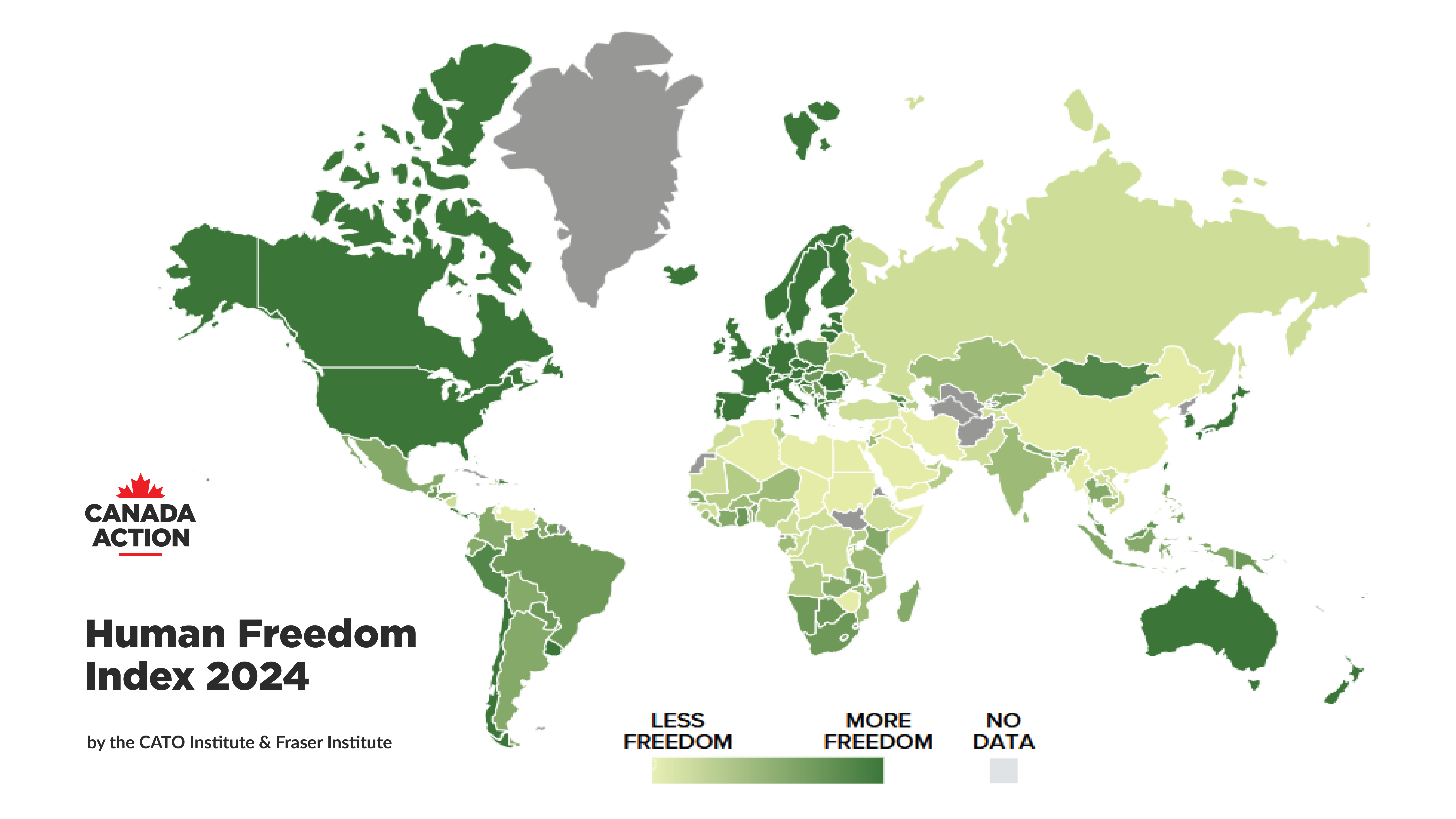
Canada has once again received top marks on the annual Human Freedom Index (HFI), ranking 12th out of 165 countries evaluated by the joint CATO Institute and Fraser Institute report [1]. Among other major resource-exporting nations, Canada ranks extremely high on the 2025 index, underscoring its status as one of the world's leading suppliers of energy, wood, food, and minerals.

Why is the HFI important, you might ask? As one of the most comprehensive indexes of its kind, it examines 87 key indicators of personal and economic freedoms, ranging from freedom of religion and movement to the rule of law and property rights. It is an all-inclusive report that quantifies how “free” a country is, often relevant for investors when considering where to put their money.

Below, we explore the top 15 countries on the Human Freedom Index 2025 and compare their rankings with those of some of the world’s top resource exporters. We also provide further insight into why Canada’s top-ranking matters in the global economy. Also see:


Canada Rankings - Human Freedom Index 2025 - Fraser Institute Cato InstituteCanada Rankings - Human Freedom Index 2025 v2 - Fraser Institute Cato Institute


Top 15 HFI 2025 Rankings

1. Switzerland
2. Denmark
3. New Zealand
4. Ireland
5. Luxembourg
6. Estonia
7. Finland
8. Czechia
9. Netherlands
10. Australia
11. Iceland
12. Canada
12. Sweden
14. Taiwan
15. United States

HFI: Summary

Canada's Human Freedom Index 2024 Rankings - CATO Institute Fraster Institute-02

The Human Freedom Index 2025 measures personal and economic freedom in 165 jurisdictions using 87 indicators across 12 areas, such as rule of law, security, movement, expression, and regulation. Scores run from 0 to 10 and are comparable from 2000 to 2023, covering 98 percent of the world’s population.

Global freedom has declined markedly since the late 2000s, with a steep drop around the COVID-19 pandemic and only a partial rebound. The average score fell from 6.97 in 2019 to 6.72 in 2021 and has remained below pre-pandemic and early-2000s levels, with nearly 90 percent of people living in countries where freedom has worsened.

Freedom globally is unevenly distributed: 13.8 percent of the world’s population lives in the freest quartile of jurisdictions, while 39.4 percent lives in the least free quartile. Switzerland, Denmark, New Zealand and Ireland are among the freest jurisdictions, whereas Myanmar, Sudan, Yemen, Iran, and Syria are among the least free. The superpowers of China and Russia rank near the bottom of the HFI 2025, similar to previous years.

Greater freedom is closely associated with greater prosperity, stronger democracy, and better outcomes, including longer life expectancy, greater tolerance, and improved regulatory performance. North America, Western Europe, and Oceania rank highest on the HFI 2025, while the Middle East and North Africa, sub-Saharan Africa, and South Asia rank lowest, including for women‑specific freedoms.

HFI: Methodology

The 11th annual edition of the HFI uses 87 distinct indicators of personal and economic freedom (both weighted 50% of the total score) to evaluate 165 jurisdictions for 2023, representing 98 per cent of the world’s population. These indicators fall into one of the following main categories:

> Rule of Law
> Security and Safety
> Movement
> Religion
> Association, assembly, and civil society
> Expression and information
> Relationships
> Size of government
> Legal system and property rights
> Sound money
> Freedom to trade internationally
> Regulation

Each indicator above has a subset of categories that are ranked on a 0-10 scale, where 10 represents the highest score. These scores are averaged and then tallied to determine the HFI rankings for each jurisdiction.

HFI 2025: Top 15 Oil Exporters

Middle East and North Africa Freedom Rankings

According to the HFI, there is a strong correlation between human freedom and all things good such as democracy, charity, tolerance, and life expectancy. Disruptions to the global energy system in recent years reinforce the importance of sourcing critical resources from reliable, low-risk suppliers. For Western European countries and those aligned with the West, such as Japan and South Korea, it is clear that freer countries are the better choice when sourcing mining, energy, forestry, and agricultural products.

Take, for example, the world’s top 15 oil exporters (ranked 1 to 15) and their corresponding ranks on the HFI 2025 index:

1. Saudi Arabia – HFI rank: 148th
2. Russia – HFI rank: 152nd
3. Canada – HFI rank: 12th
4. Iraq – HFI rank: 150th
5. UAE – HFI rank: 121st
6. USA – HFI rank: 15th
7. Norway – HFI rank: 12th
8. Kuwait – HFI rank: 113th
9. Nigeria – HFI rank: 123rd
10. Brazil – HFI rank: 66th
11. Libya – HFI rank: 156th
12. Angola – HFI rank: 115th
13. Oman – HFI rank: 122nd
14. Mexico – HFI rank: 91st
15. Kazakhstan – HFI rank: 105th

Why the Human Freedom Index Matters

Canadian hands with flag embedded

The HFI's comprehensive measurement of indicators such as the ability to enjoy freedom of speech, religion, and association and assembly helps quantify societal well-being, attracting capital investment, and identifying areas for improvement.

More “free” countries tend to have safer environments in which democratic rule of law is upheld and enforced. In 2023, the world’s freest nations in the top quartile had a much higher average per capita income of $53,635, compared with $14,201 for the least free quartile of countries [1].

In other words, the freer a country is, the more likely it is to be attractive to like-minded investors. Don’t get us wrong; many countries do not care where their resources come from, as long as they come. However, in recent years, resource security has been put at the forefront by many Western nations, which have found themselves over-reliant on foreign actors that have used energy and minerals, for example, as instruments of coercion.

As geopolitics continue to change in the global economy and create enormous uncertainty, it is commonplace for Western investors to focus on expanding their portfolios in countries with high levels of freedom and democracy [3]. Unsurprisingly, the HFI found a strong relationship between human freedom and democracy.

The World Needs More Canada

i love canadian oil and gas banner

Canada has exceptional HFI performance relative to many other leading resource-exporting countries. However, despite how “free” our country may be, it faces several regulatory and political risks that have deterred business investment over the past decade.

It’s time for Canada to turn things around, streamline its regulatory processes, remove self-imposed trade barriers, and start attracting new capital investment back into the country.

Canada is among the leading producers of natural resources globally. For our allies and trade partners, we should be one of the last ones “out of the pool” to supply the world with the energy, food, wood and minerals it needs!

Join Us Today!

SOURCES:

1 – https://www.cato.org/human-freedom-index/2024

2 - https://www.worldstopexports.com/worlds-top-oil-exports-country/

3 - https://alphaarchitect.com/2022/10/democracy-stock-returns/