Alberta Sitting on World’s Third-Largest Lithium Reserves Worth $1.4 Trillion: REPORT

Alberta Sitting on World’s Third-Largest Lithium Reserves Worth $1.4 Trillion: REPORT

Alberta has third largest lithium reserves in the world

It’s no secret that Canada has an immense wealth of natural resources in the ground — $33 trillion worth, according to some of the latest figures [1]. In Alberta’s case specifically, it is already a top-five global oil reserve holder and, according to a new Alberta Geological Survey (AGS) report, could also be among the top five for lithium [2].

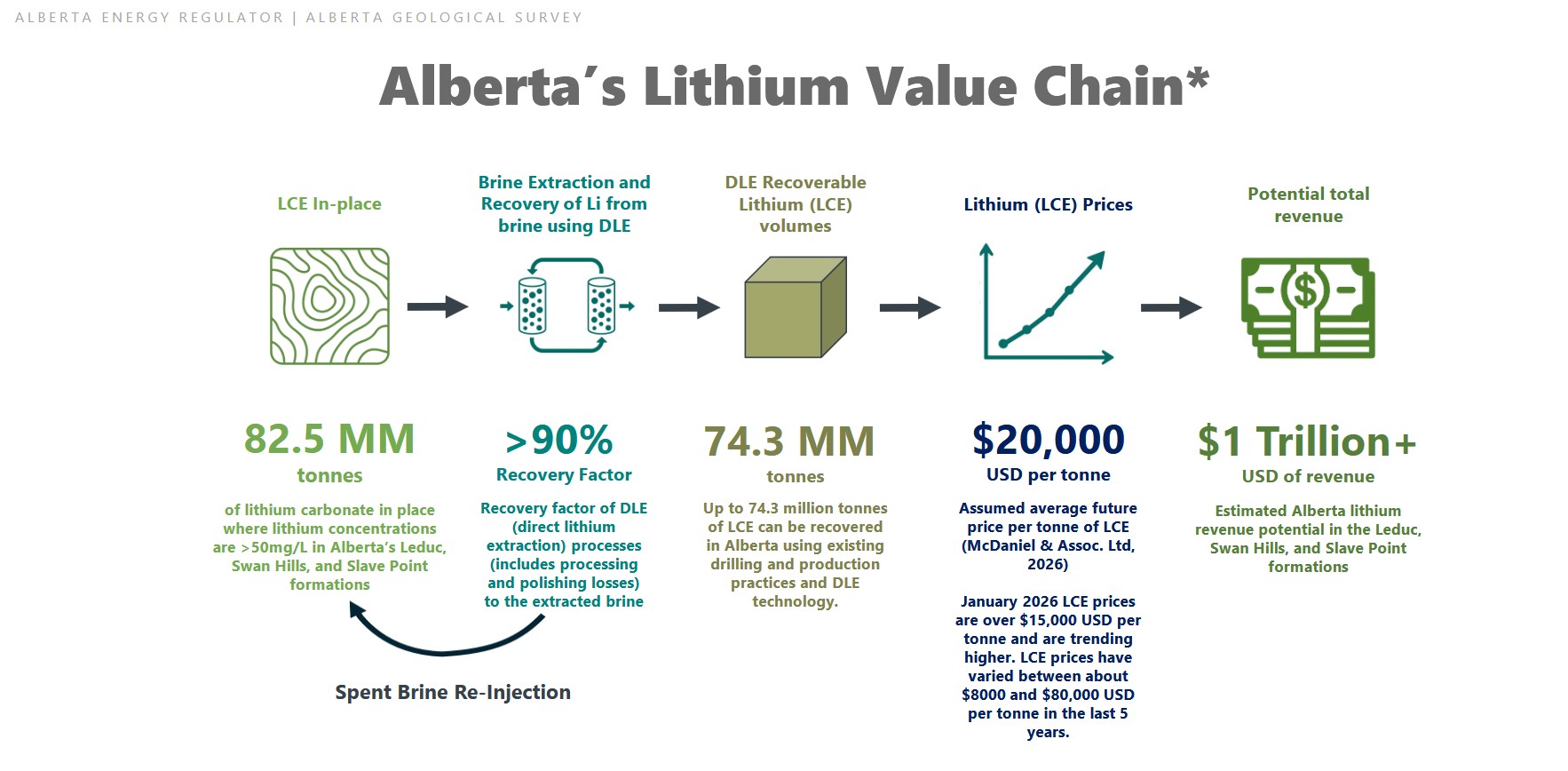
AGS says the Western Canadian province could be sitting on 82.5 million tonnes of lithium carbonate in-place, worth nearly $1.4 trillion at today’s USD to CAD exchange rate. For perspective, this would be enough of the critical mineral to supplement the manufacturing of approximately 1.9 billion electric vehicle (EV) batteries [2].

If developed, Alberta could become a top global lithium supplier, helping support the build-out of advanced batteries while creating immense economic opportunities for Canadians here at home.
Key Highlights 

banner sticker - pipelines, power lines, ports, railways and roads

  • AGS identified 82.5 million tonnes of lithium carbonate equivalent (LCE), the product of years of rigorous data collection funded by the provincial government
  • 95%, or 77.7 million tonnes of LCE identified, is concentrated in the Devonian Leduc Formation
  • Swan Hills and Slave Point formations hold 4.8 million tonnes of LCE in-place
  • A staggering 1.9 billion EV battery packs could be manufactured using the LCE in-place, showing the sheer scale of these reserves and their potential to support advanced battery production
  • Nisku formation shows elevated lithium concentrations, with a formal estimate pending more data collection
  • Using Direct Lithium Extraction (DLE) technology and a conservative estimate of USD $20,000 per tonne of battery-grade LCE, Alberta could theoretically generate revenue exceeding USD $1 trillion – approximately CAD $1.4 trillion using today’s exchange rate
  • Today, 2 million hectares are already leased by various private companies for lithium exploration and development in Alberta

Alberta Lithium Reserve Locations

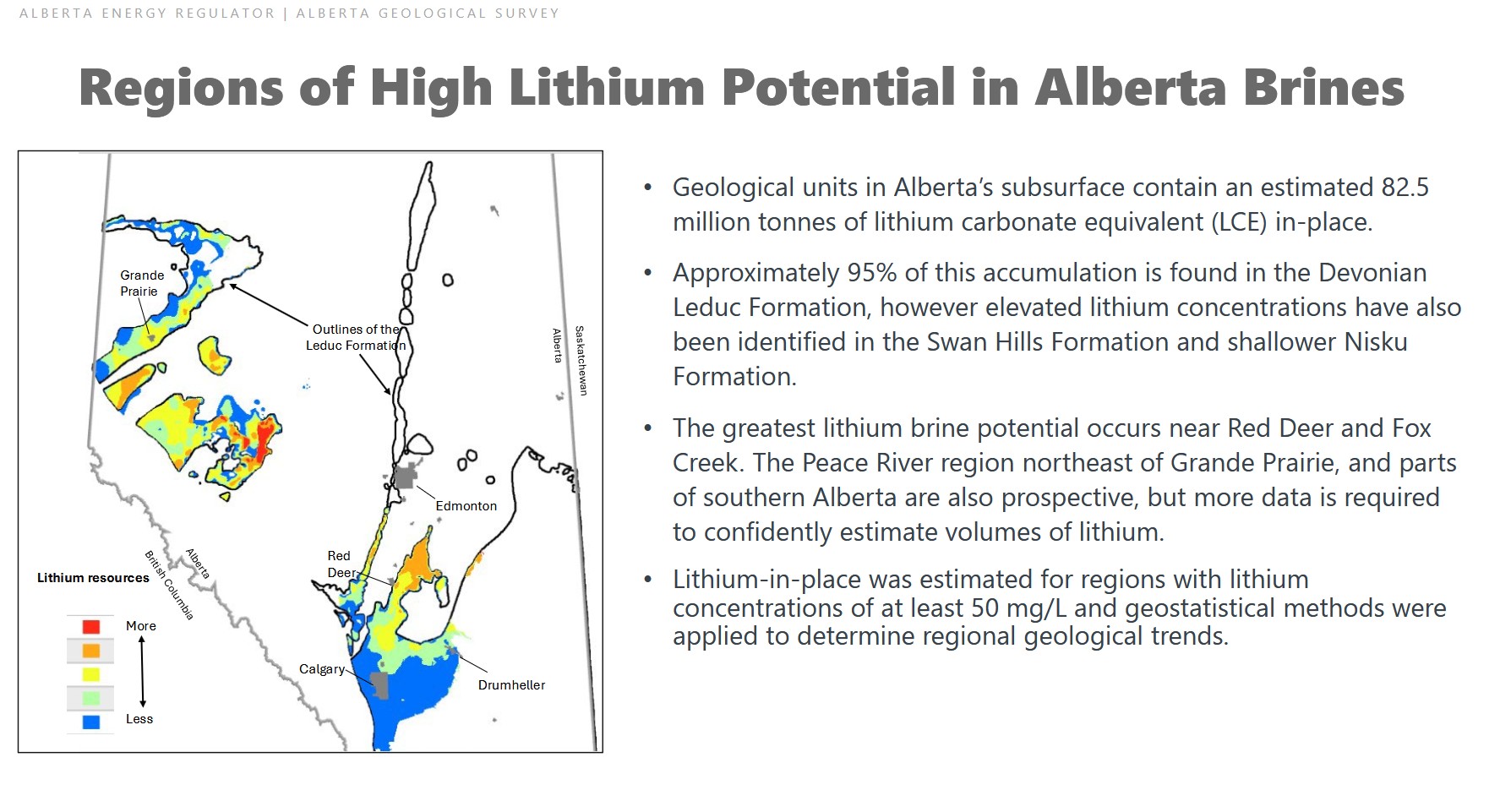
Regions of Alberta with high lithium potential

Alberta Geological Survey

Alberta's lithium isn’t scattered randomly beneath the surface, but rather is in underground concentrated pockets within geological formations that Canadian oil and gas producers already know extremely well.

Nearly 95% of the total LCE resource is located in the Devonian Leduc Formation, the same geological unit whose 1947 oil discovery launched Alberta's modern petroleum industry and set Canada on a path to generational prosperity. The Leduc Formation alone holds an estimated 77.7 million tonnes of LCE in-place, already extensively explored by energy producers across the Edmonton-Calgary corridor, the Fox Creek region, and the Peace River area [2]

The Swan Hills and Slave Point formations contribute a further 4.8 million tonnes of LCE in-place. Although their current data coverage is limited, localized regions of elevated lithium concentrations have already been identified, and there is significant potential for these numbers to grow as more sampling is completed, according to AGS [2].

The Nisku Formation represents additional upside for LCE reserves in Alberta. Its reefs share similar geological characteristics to the Leduc and Swan Hills formations and are in contact with them in some places – potentially adding to the thickness of the lithium-rich zone. Current samples show relatively high lithium concentrations in Nisku; more data and analysis are needed before AGS can make a formal in-place resource estimate [2].

The greatest lithium brine potential identified is found near Red Deer and Fox Creek, with prospective regions also in the Peace River area northeast of Grande Prairie.

Decades of oil and gas production have left behind a rich inventory of sampled wells and subsurface data that directly informed AGS's study.

Canada, An Ideal Lithium Supplier

Alberta's Lithium Value Chain

Alberta Geological Survey

The timing of Alberta's potential lithium reserve discovery could not be more strategically significant, with global demand expected to grow rapidly over the next several years. For example, worldwide consumption is expected to increase by nearly 46% by 2030, largely due to its key role in the production of energy storage technologies [3]. Global lithium production totalled 237,000 tonnes in 2024, with Canada's contribution a mere 5,983 tonnes, representing about 2.5% of global output [4].

Today, virtually all of the world’s lithium supply chain runs through Chile, Argentina, China, and Australia. China also accounts for around two-thirds of global lithium processing [4].

In an era when G7 leaders have described critical minerals as the building blocks of energy-secure economies of the future, where supply chain security has become a cornerstone of geopolitical strategy, Canada's position as a potential top-three lithium supplier is both an immense opportunity and a strategic imperative.

Alberta's lithium resources could supply battery material for an estimated 1.9 billion EV battery packs, putting its potential contribution to global energy storage supply into a tangible perspective. The province already has approximately 2 million hectares leased for lithium exploration, while the provincial government has set an ambitious target to commence commercial production as early as 2027.

What Alberta’s Lithium Means for Canadians

Canada Action - blog banner supporter banner

Natural resource development helps lift the living standards for all Canadians, and lithium could be a major new chapter in that story.

The economic opportunity presented by Alberta's lithium resources would extend well beyond provincial borders. Like Alberta's oil and gas revenues, lithium development and the investment that would flow from it would help boost the national economy, supporting jobs in engineering, construction, technology, logistics, manufacturing, retail, and professional services from coast to coast.

The discovery also arrives at a moment when Canada's broader economic conversation is dominated by concerns about low productivity, trade vulnerability, and the pressing need for high-quality, highly productive per-capita GDP growth.

Development of this world-class resource, using made-in-Alberta technology and Canadian expertise, would generate the kind of durable, export-driven wealth that strengthens the entire country. It would create skilled jobs, attract billions in private investment, generate royalties to fund public services, and position Canada as a trusted, reliable supplier of critical materials to allies seeking stable, democratic supply chains.

Canada has the lithium, the expertise, infrastructure, and geological endowment to become one of the world's most important suppliers of a critical mineral that the global economy cannot do without. What it needs now is the ambition and the resolve to develop it. Alberta has already taken the first steps; now it is time to deliver.

The world needs more Canadian minerals and metals!

SOURCES:

1 - https://www.voronoiapp.com/natural-resources/Ranked-Top-Countries-by-Natural-Resource-Value-2885

2 - https://static.ags.aer.ca/files/document/INF/INF_159.pdf

3 - https://www.spglobal.com/energy/en/news-research/latest-news/metals/010826-battery-storage-to-drive-lithium-demand-growth-globally

4 - https://natural-resources.canada.ca/minerals-mining/mining-data-statistics-analysis/minerals-metals-facts/lithium-facts