New Ontario Nuclear Reactor Could Generate $238 Billion in GDP for Canadians: REPORT

New Ontario Nuclear Reactor Could Generate $238 Billion in GDP for Canadians: REPORT

Canada Bruce C Project in Ontario could be a major economic and energy security force for Canadians

Over the past year, Ontarians have overwhelmingly polled in support of major natural resource and trade infrastructure projects. Today, one of the most exciting potential developments in the province is undoubtedly the Bruce C Project, which will not only supplement Ontario’s growing electricity needs, but also provide immense job opportunities and economic benefits for Canadians.

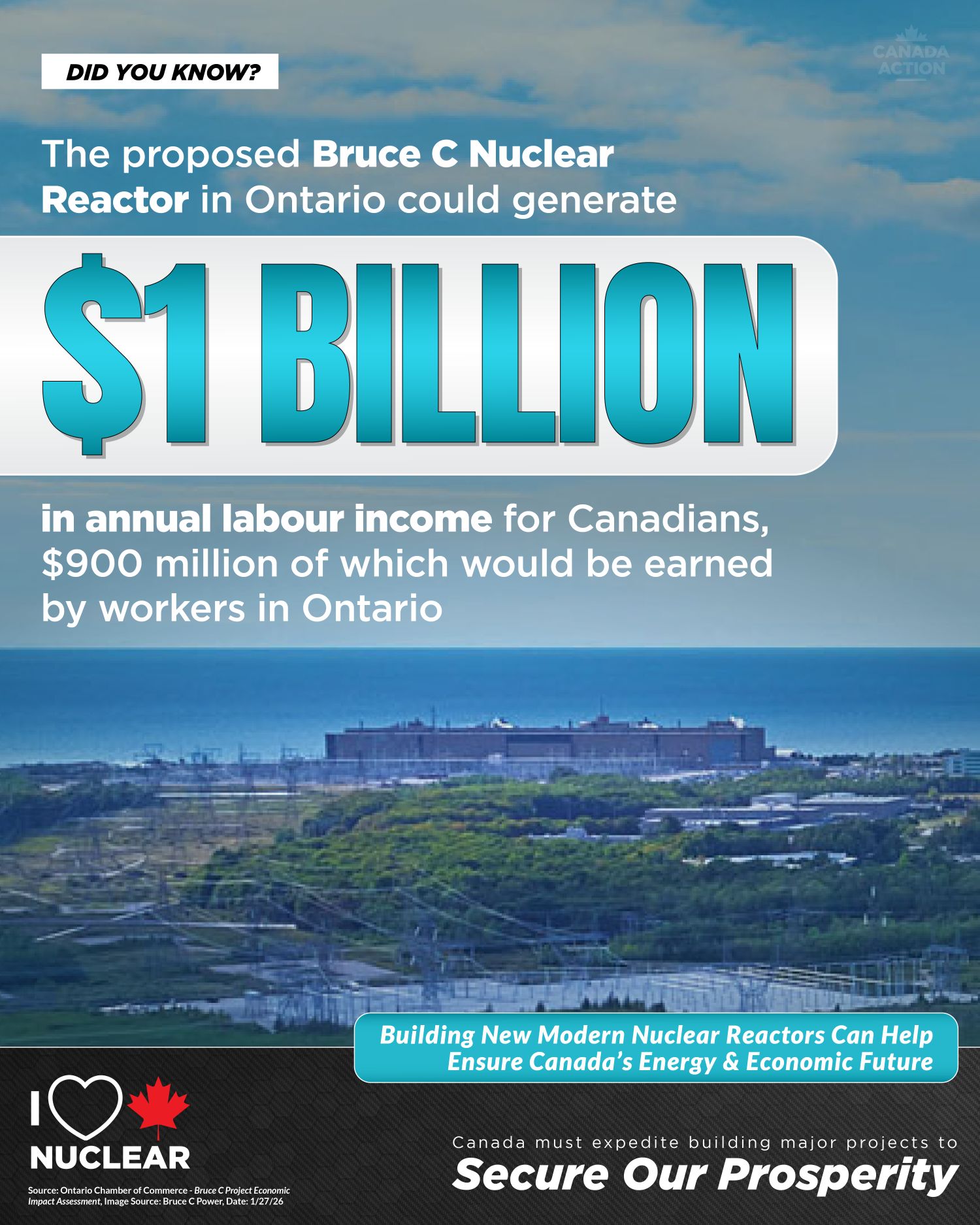
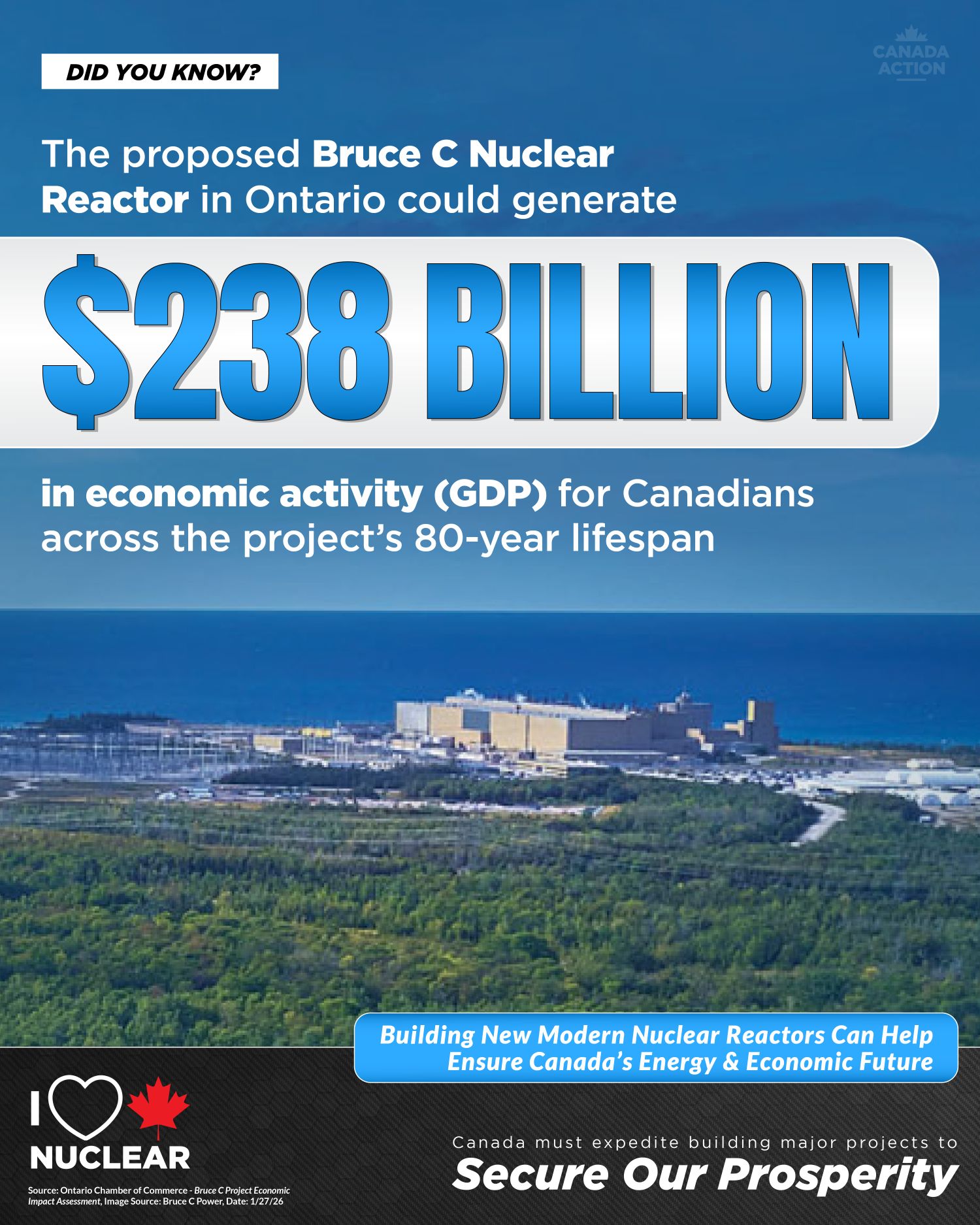
According to a report by the Ontario Chamber of Commerce (OCC) [1], the new modern reactor project could contribute an estimated $238 billion in total gross domestic product (GDP) over its 80‑year lifespan. Approximately $217 billion of that total would be in Ontario [2]. Locally, it would add $2.3 billion per year to GDP in Bruce, Grey, and Huron counties. Job-wise, tens of thousands of full-time equivalents (FTEs) would be supported during construction and operations, and $1 billion in annual labour income would go to the pockets of workers.

Like the Bruce A and Bruce B reactors, the Bruce C Project would provide reliable, around-the-clock electricity, supporting households, manufacturers, data centres, and Ontario's growingly electrified economy. If approved, the new nuclear reactor would be built likely for well over a decade at the existing Bruce Power site on Lake Huron, already one of the world’s largest nuclear generating stations.
Bruce C Project: Key Highlights

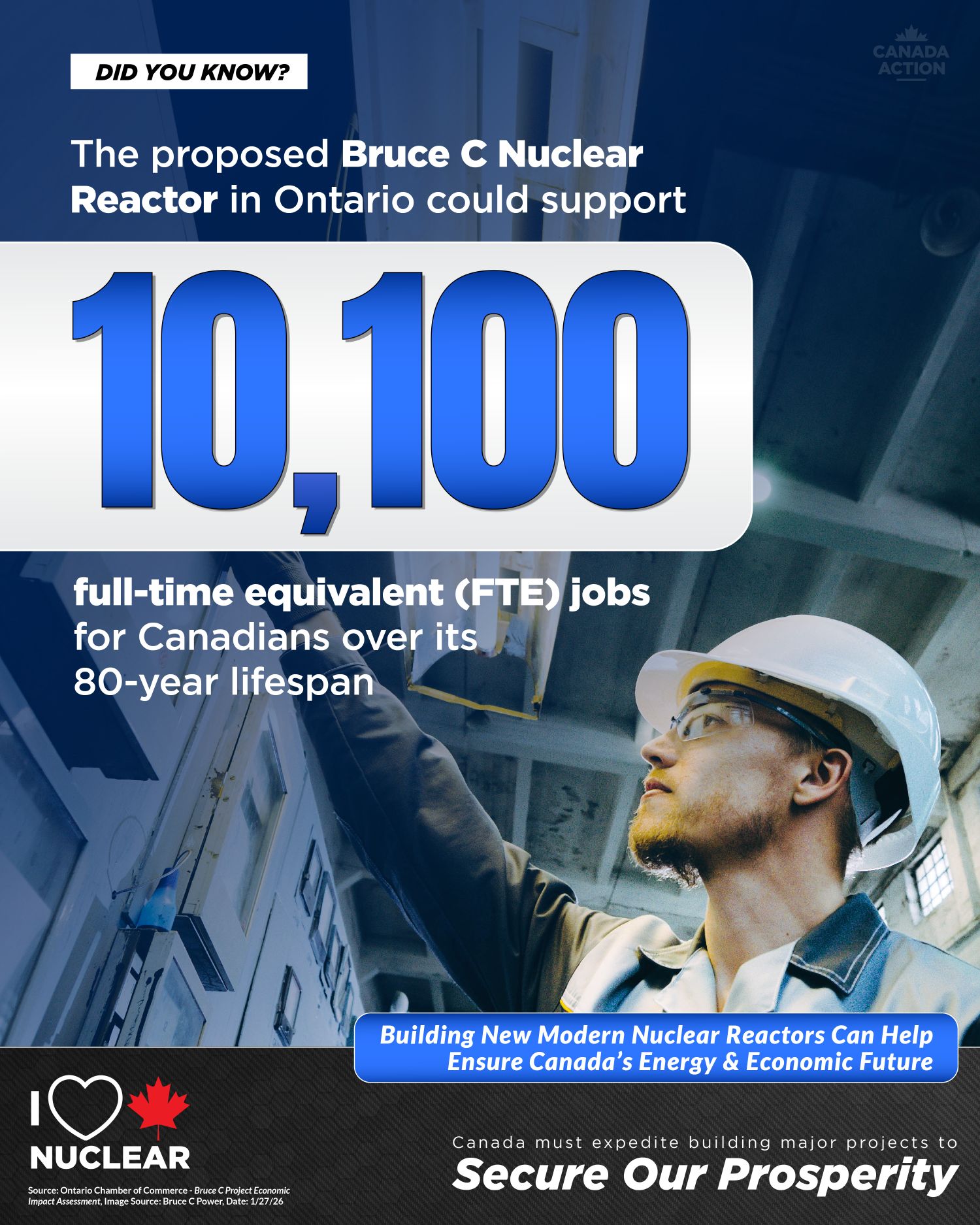
Bruce C Nuclear Reactor could support 10,000 full-time jobs

Total economic impact: $238 billion in GDP over an 80‑year project life [1]

Employment (Construction): 18,900 FTE jobs, including 15,900 in Ontario [2]

Employment (Operations): 6,700 FTE jobs, including 5,900 in Ontario [2]

Employment (Full Life): 10,000 FTE jobs, including 8,700 in Ontario [2]

Labour Income: $1 billion would be earned by workers, including $900 million in Ontario [2]

Salary & Wages: Workers directly employed would earn $179,000 on average for salary, and those employed in upstream industries supporting the project would earn an average salary of $73,000 per year

Tax Revenues: Average annual income taxes are estimated at $100 million federally and $55 million provincially. Indirect tax revenues include $35 million federally, $70 million annually, and $55 million for local governments within the Bruce, Grey, and Huron counties.

Positive Impact on Canadian Communities

Bruce C Nuclear Reactor could generate 238 billion CAD in economic activity in Canada, mostly in Ontario, over its lifespan

The Bruce C Project would be an economic anchor for the surrounding area and Ontario as a whole. During its multi-year construction timeline, local businesses would see a surge in demand for accommodations, restaurants, retail, transportation, and other services, providing a major boost to small and medium‑sized businesses. The influx of skilled tradespeople, engineers, and support staff would help sustain local employment well beyond the initial build phase.

Over its multi-decade operations, the new reactor would support long‑term, high‑quality careers in plant operations, maintenance, safety, engineering, and administration. Many of these roles are among the best‑paid and most stable jobs around, and they also offer apprenticeships, training programs, and long-term career paths for local residents and young people entering the workforce.

Municipalities near the Bruce C site stand to benefit from steady tax revenues and community investments linked to the facility, totalling tens of millions of dollars annually. These would fund improvements to local infrastructure, health services, emergency response, recreation facilities, and educational programs.

Canada’s Electricity Demand is Growing

Bruce C Nuclear Reactor project could provide 1 billion CAD in annual income to workers

It’s no secret that Canada’s electricity demand is growing rapidly. In Ontario alone, demand is expected to increase by 75 per cent by 2050 [3] while Canada could see its power supply needs double or even triple by 2050 [4]. The surging trend – driven by artificial intelligence, data centres, EVs, industrial electrification, home heating, population growth, etc. – requires massive additions of firm, dispatchable power that can operate around the clock, regardless of weather or time of day.

Nuclear reactors are uniquely well-positioned to provide that kind of reliable baseload power for decades. Projects like Bruce C are therefore not only critical, irreplaceable economic drivers for the Canadian economy; they are essential energy infrastructure needed to keep the lights on at home and businesses and factories running as demand soars.

Today, Ontario gets about 50% of its electricity from nuclear reactors, with hydro (24%), gas/oil (16%), wind (9%), solar(<1%), and biofuel (<1%) also playing a role [5]. Because nuclear power is reliable and provides a steady, constant electricity supply that rarely changes, it, along with hydro, is a first choice to meet Ontario’s energy needs [5].

Canada Needs Modern Nuclear Reactors

Time for Action and Build Nuclear Now

Projects like Bruce C are exactly the kind of nation-building infrastructure Canada needs to secure good jobs and long-term economic prosperity here at home. By supporting this new reactor and other potential projects like it, Canadians are backing thousands of high-paying careers, billions in economic opportunity, and the reliable power supply our communities and industries need to grow for generations.

Join us today to learn more about the positive economic impact major energy projects like the Bruce C Reactor can have on Canadians and why we must take action now to build a better future.

SOURCES: