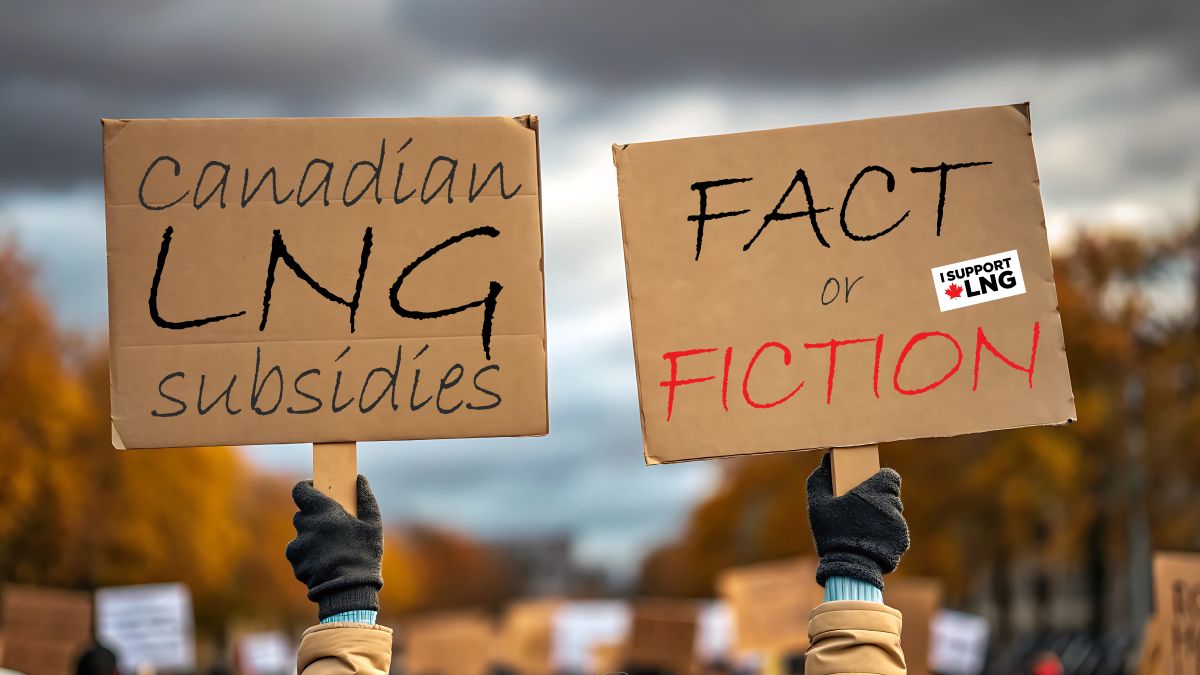
Canadian LNG Subsidies: Fact or Fiction?

Canadian LNG Subsidies: Fact or Fiction?

LNG subsidies in Canada - fact or fiction

The International Institute for Sustainable Development (IISD) seems to think that the world doesn’t need Canadian liquefied natural gas (LNG). But that’s just not true.

A recent report from the think tank paints a misleading picture of Canada's involvement in its growing LNG sector, suggesting that Canadian taxpayers are unfairly footing the bill for its expansion. This manufactured narrative intentionally blurs the lines between actual costs and accounting choices, while ignoring the immense benefits of natural gas development for Canadian and Indigenous families.

Canada's support for its LNG industry isn't a corporate handout; it's a strategic investment poised to generate substantial returns for Canadians and foster unprecedented Indigenous economic partnerships, paving the way towards a stronger, more prosperous future for the country.

Through LNG development, Canada is responding to the calls of numerous global leaders who have requested access to Canadian LNG to help diversify energy supplies and enhance energy security.

Deconstructing the Misleading "Subsidy" Narrative

The IISD report captures headlines with a figure of nearly $4 billion in "support" for Canada’s developing LNG sector. However, this number is deeply misleading as it conflates various financial mechanisms to create an inflated sense of public cost.

#1 - Government Spending vs. Strategic Accounting

First, the IISD blurs the line between real government spending and strategic accounting. Billions of dollars in “subsidies” cited in the referenced report are not cash from government coffers, but rather foregone revenue, such as provincial sales tax deferrals during the construction phase, or adjustments to corporate tax rates once a project becomes profitable [1]. These are not handouts; they are conditions for attracting capital investment.

Much of the IISD's supposed "support" for LNG development is not government spending but foregone revenue. These incentives are not handouts; they are standard methods used by jurisdictions to attract capital. Crucially, if a project does not proceed and generate income, this "foregone" tax revenue would never exist in the first place. The same logic applies to the carbon tax revenues mentioned in the IISD report.

Incentivizing measures offered by provincial and federal governments can make the difference between attracting tens of billions of dollars of job-creating investment into Canada—or losing out on that investment and the jobs that go with it altogether.

The report also tallies public finance loans among its list of Canadian LNG subsidies [1]. Presenting the full value of a loan as a public cost is a misleading accounting method. These are commercial arrangements that are fully repayable—often with interest—generating a return for the public purse, not draining it.

#2 - Global LNG Demand is Growing

With global LNG consumption projected to double by 2050 [2], it appears that the IISD is attempting to prevent Canada from becoming a major supplier, a move that only benefits other jurisdictions abroad.

The reality is that “If you’re not buying oil and gas from Canada and British Columbia, the alternative is Venezuela,” B.C. Premier David Eby said earlier this year, when discussing market diversification for Canadian goods that could be impacted by U.S. tariffs [3].

And according to the federal government, Canada is the best supplier for the job.

“Our LNG is the lowest-risk and the lowest-carbon in the world. Lowest-risk because — like Germany — Canada is a G7 democracy,” said Energy and Natural Resources Minister Tim Hodgson when visiting Europe in August [4].

“That means when you buy Canadian LNG, you are buying supply that cannot be turned off by politics or coercion. And lowest-carbon because Canadian LNG has among the lowest upstream emissions globally, backed by strict methane rules and an 80 percent non-emitting electricity grid.”

By omitting these facts, the IISD's analysis fails to present a balanced view of Canada's competitive advantages in the global LNG market.

#3 - Ignoring LNG Projects and Indigenous Economic Reconciliation

Another major oversight in the IISD report is its failure to acknowledge LNG development as a cornerstone of Indigenous economic reconciliation. The Haisla Nation’s Cedar LNG project—the largest Indigenous majority-owned infrastructure project in Canadian history—is a great example. This facility is to be supplied by the Coastal GasLink pipeline, in which 17 First Nations along its route now hold a 10% equity stake [5].

Indigenous ownership provides these communities with real decision-making power, long-term economic partnership, and a pathway to prosperity. The socio-economic benefits are substantial. Cedar LNG, LNG Canada, and Coastal GasLink have delivered well-paying jobs, career training, and supply chain contracts to Indigenous associated businesses. These major projects generate meaningful own-source revenues that fund local priorities—healthcare, housing, and community development—directly supporting Indigenous self-determination.

Perhaps most importantly, the economic opportunities that come with LNG development have allowed Indigenous youth and families to build their futures within their traditional homelands, strengthening communities—not emptying them.

First Nations are shaping Canada's energy future by forging lasting economic security through real partnerships and participation in LNG development, a clear and powerful engine for Indigenous self-determination and reconciliation.

#4 - Ignoring the Benefits of Canadian LNG Development

Perhaps the most glaring omission in the IISD's analysis is its complete failure to account for the benefits of natural gas development. The LNG Canada Phase 1 project, for instance, was made possible by $40 billion in job-creating private investment. Governments did not build the plant; private capital did. LNG Canada’s latest update announced $5 billion in spending on contracts and procurement from B.C.-based businesses, including $4.1 billion to local and Indigenous-owned companies [6].

The public’s contribution to LNG Canada was a small, upfront fraction of this total cost, primarily directed towards infrastructure, including the $55 million Haisla Bridge replacement [7]—assets that benefit the entire community, not just the project. And in return for this modest initial support, Canadians are poised to benefit substantially.

With Phase 1 operational as of 2025, a steady stream of government revenue has already begun to flow. This includes royalties, corporate taxes, personal income taxes from thousands of well-paid jobs, and municipal taxes that fund local services. One estimate suggests that LNG exports could boost Canada’s gross domestic product (GDP) by up to $75 billion annually [8].

A study by the Conference Board of Canada found that from 2020 to 2064, more than $90 billion in revenue could be generated for provinces and territories, with over $78 billion going to B.C. Additionally, the federal government could expect to see $64 billion in additional revenues from a healthy 56 million tonnes per annum (mtpa) LNG sector on the West Coast. Just over 50 mtpa of export capacity is proposed, under construction, or operating in Canada [9]. These aren't just numbers; they are revenues our governments use to expand healthcare, education, and other critical social programs that underpin Canadians' standard of living and quality of life.

A Partnership for Prosperity and Security

Framing government incentives for LNG development as a "subsidy" is a fundamental misunderstanding of how major industrial projects are built. Preferential tax rates or deferrals, for example, are not free gifts, but powerful tools that help attract the substantial private investment required for major developments to proceed. Without these strategic accounting methods, there’s a good chance that Canada’s LNG projects would go elsewhere.

Historically, Canada’s lack of support for LNG led to the cancellation of several major projects, resulting in hundreds of billions of dollars in lost job-creating investment. Canadians cannot afford to miss out on those opportunities again.

By supporting a robust LNG industry, Canada’s governments are helping to stimulate the economy by creating well-paying jobs, supporting businesses, and generating public revenues to help fund essential social programs such as healthcare and education.

In conclusion, the IISD report incorrectly portrays Canadian LNG subsidies as a problem. The reality is clear: promoting LNG development helps unlock private investment and creates high returns for Canadians for generations to come.

SOURCES:

1 - https://www.iisd.org/system/files/2025-09/government-support-lng-british-columbia.pdf

2 - https://corporate.exxonmobil.com/sustainability-and-reports/global-outlook

3 - https://calgaryherald.com/opinion/columnists/varcoe-canadian-support-sea-to-sea-pipelines-trump-tariffs-threat

4 - https://www.canada.ca/en/natural-resources-canada/news/2025/08/the-honourable-tim-hodgson-minister-of-energy-and-natural-resources-securing-the-future-advancing-canadagermany-cooperation-on-transatlantic-energy.html

5- https://calgaryherald.com/business/energy/coastal-gaslink-pipeline-fully-installed-tc-energy

6 -  https://www.lngcanada.ca/news/lng-canada-2024-fall-update/

7 - https://www.terracestandard.com/news/feds-announce-funds-to-replace-kitimats-haisla-river-bridge-6039569

8 - https://financialpost.com/commodities/energy/oil-gas/canada-burgeoning-lng-industry-measure-up-ambitions

9 - https://natural-resources.canada.ca/energy-sources/fossil-fuels/canadian-liquified-natural-gas-projects