Canada Ranks 13th on WJP's Rule of Law Index 2025

Canada Ranks 13th on WJP's Rule of Law Index 2025

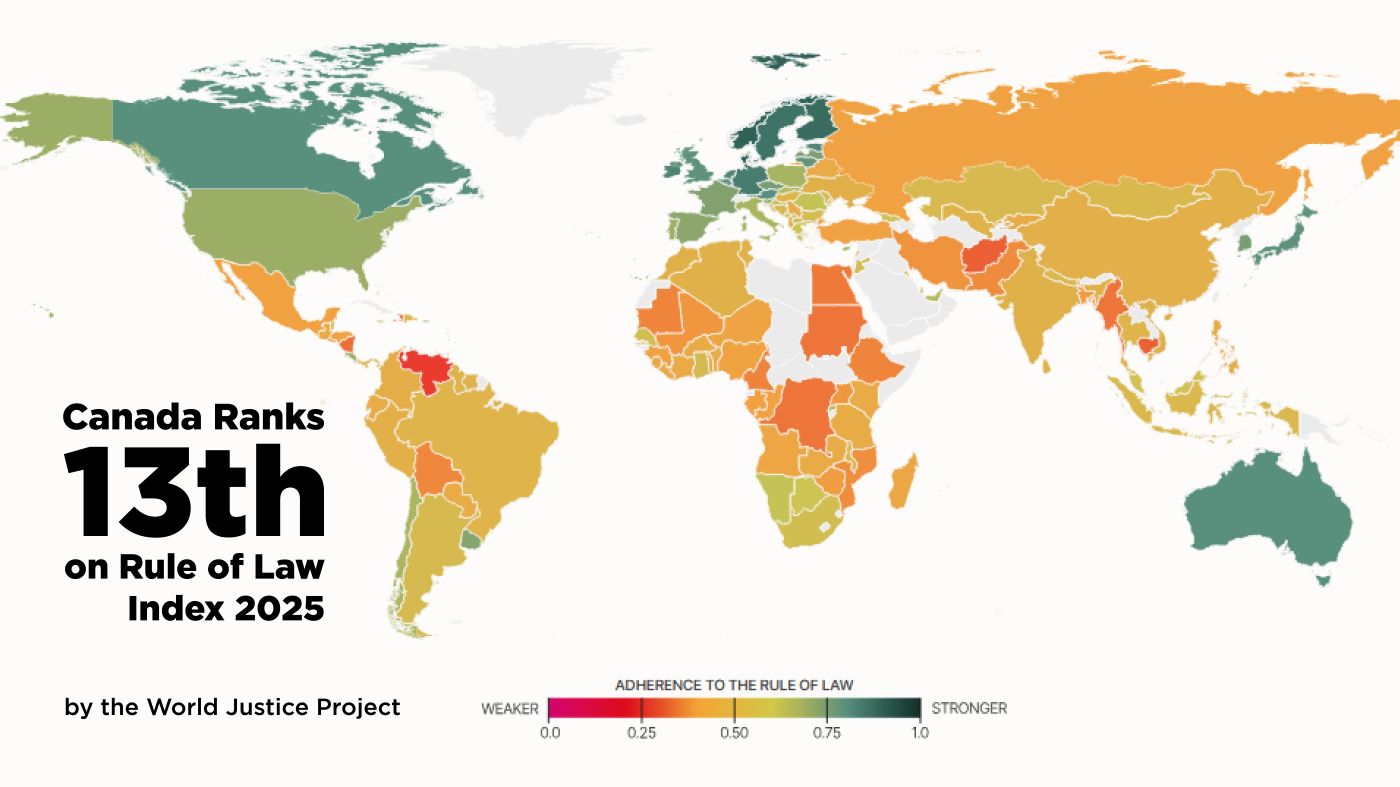
Canada Ranks 13th on Rule of Law Index 2025

Canada has managed to rank consistently high among its Western peers on yet another global index, showing just how reliable our country is as a major supplier of resource-based products versus many of our international competitors.

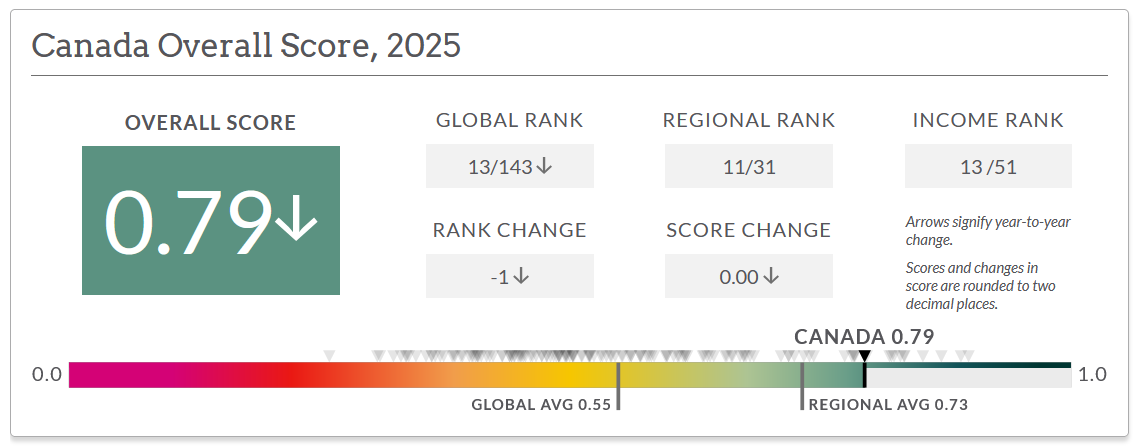
The World Justice Project’s (WJP) Rule of Law Index measures how the rule of law is experienced and perceived by the public in 143 countries and jurisdictions. In its 16th annual edition, Canada placed 13th globally with an overall score of 0.79 out of 1.0 (the higher, the better), down from 12th year-over-year, but still reaffirming our country’s status as an orderly and rules-based society.

Canada sits in the top tier of nations committed to a society where laws are clearly defined, justly applied, and protective of fundamental human rights. Our exceptional performance on the WJP’s latest index and others like it is a testament to our stable democratic governance and institutions – we should be proud!
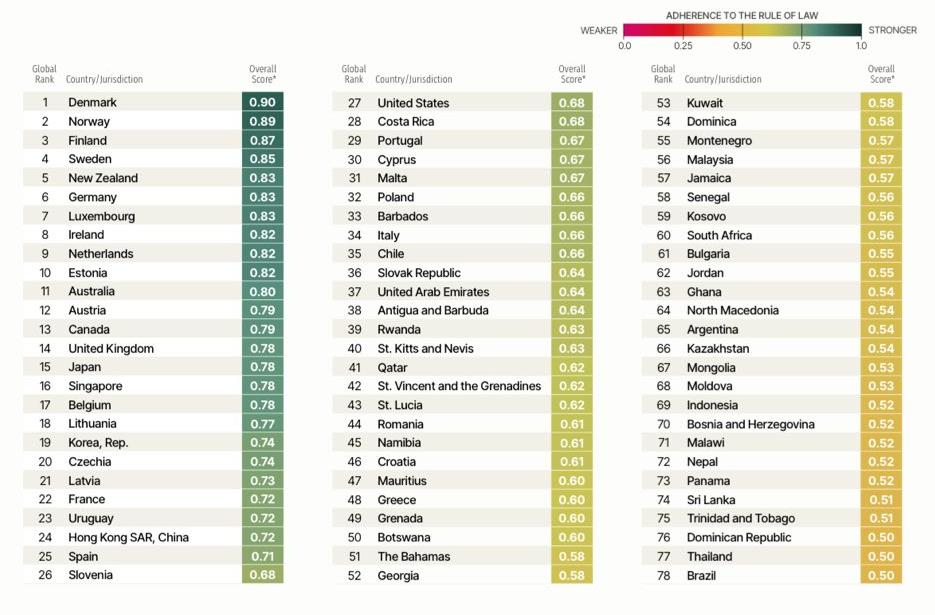
Top 15 Countries Where “Rule of Law” Prevails (2025)

Rule of Law Index 2025 - Country Rankings 1 to 78

Courtesy of WJP

  1. Denmark — 0.90/1.00
  2. Norway — 0.89
  3. Finland — 0.87
  4. Sweden — 0.85
  5. New Zealand — 0.83
  6. Germany — 0.83
  7. Luxembourg — 0.83
  8. Ireland — 0.82
  9. Netherlands — 0.82
  10. Estonia — 0.82
  11. Australia — 0.80
  12. Austria — 0.79
  13. Canada — 0.79
  14. United Kingdom — 0.78
  15. Japan — 0.78

Index Highlights

Global decline: The 2025 WJP Rule of Law Index shows that rule of law has declined in a majority of countries for yet another consecutive year, extending a worrying multi‑year global trend of erosion rather than improvement.

Widespread erosion: Most regions and income groups are affected, with backsliding not confined to fragile states; even established democracies and middle‑ and high‑income countries are showing stagnation or decline on key rule of law indicators.

Constraints weakened: One of the sharpest areas of deterioration is in constraints on government powers—including checks and balances, judicial independence, and accountability mechanisms—signaling growing space for executive overreach.

Rights pressures: Indicators tied to fundamental rights—such as freedom of expression, association, and privacy protections—continue to lose ground in many countries, underscoring a shrinking civic space and more frequent rights violations.

Justice gaps: Both civil and criminal justice systems show persistent gaps in accessibility, affordability, and fairness; many people still cannot resolve everyday legal problems effectively or receive fair treatment in criminal processes.

Security concerns: Measures of order and security reflect how violence, crime, and conflict continue to undermine the rule of law in a significant number of countries, particularly where institutions are weak or politicized.

Corruption persistence: Absence of corruption remains a chronic challenge; petty and grand corruption in the executive, legislature, judiciary, and police continues to distort how laws are applied and public resources are used.

Regulatory quality: Scores relating to regulatory enforcement highlight uneven, inconsistent, or politically biased application of regulations, which undermines predictability for citizens and businesses and weakens trust in institutions.

Country variations: While a minority of states show incremental improvements, the Index finds that positive change is typically modest and often outweighed at the global level by larger or more numerous declines across other countries.

Policy urgency: The WJP’s 2025 results underscore an urgent need for renewed commitment from governments, civil society, and international partners to strengthen rule‑of‑law institutions, protect rights, and close justice gaps, framing the rule of law as central to economic development and democratic resilience.

Rule of Lax Index: Methodology

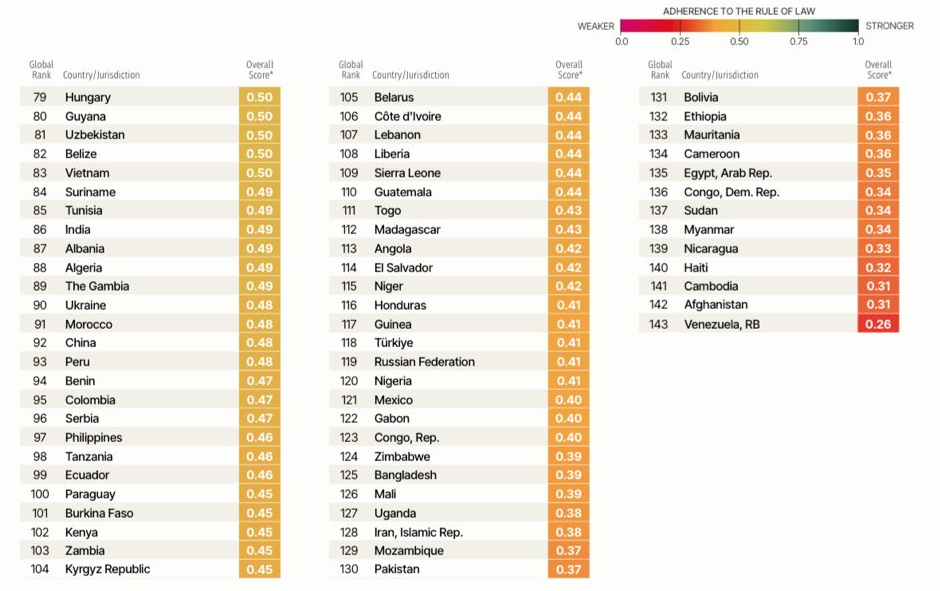
Rule of Law Index 2025 - Country Rankings 79 to 143

Courtesy of WJP

WJP’s Rule of Law Index is a comprehensive assessment based on national surveys of more than 214,000 households and 4,100 legal practitioners and experts across 143 jurisdictions worldwide. It evaluates performance across eight key factors:

  1. Constraints on Government Powers – Measures the extent to which executive authority is effectively limited by the legislature, judiciary, independent oversight bodies, and a free press.
  2. Absence of Corruption – Assesses whether public officials in the executive, legislative, judicial, and security branches use their positions for private gain.
  3. Open Government – Evaluates the transparency of laws and government data, the accessibility of information, and opportunities for public participation in policy-making.
  4. Fundamental Rights – Examines how well a country upholds internationally recognized civil, political, and labour rights such as freedom of expression, religion, and privacy.
  5. Order and Security – Looks at how effectively a society prevents crime, maintains civil peace, and protects individuals from violence.
  6. Regulatory Enforcement – Gauges the fairness and effectiveness with which regulations are applied and enforced, ensuring they are administered without improper influence or unreasonable delay.
  7. Civil Justice – Reviews the accessibility, affordability, and impartiality of the civil court system, including whether disputes are resolved without discrimination or corruption.
  8. Criminal Justice – Measures the effectiveness, impartiality, and due-process guarantees of the criminal justice system from investigation through adjudication and correction.

A score of 1.0 represents the strongest adherence to the rule of law, while 0 signifies the weakest. Canada’s consistently high ranking on the Rule of Law Index throughout the years reflects our nation’s deep-rooted commitment to a just and rights-respecting society.

Canada's Rankings by Category

Canada Rule of Law Index 2025 - Overall ranking

Canada’s overall rank of 13th with a score of 0.79 is slightly lower year-over-year, demonstrating its relative stability in a world where the rule of law is seeing declines in many countries. This score places Canada 11th out of 31 countries in the "EU, EFTA, and North America" region and 13th among 51 high-income countries.

Here’s a breakdown of Canada’s performance across the eight factors:

  • Constraints on Government Powers: 0.82 (13th globally)
  • Absence of Corruption: 0.82 (14th globally)
  • Open Government: 0.79 (12th globally)
  • Fundamental Rights: 0.82 (13th globally)
  • Order and Security: 0.90 (16th globally)
  • Regulatory Enforcement: 0.81 (13th globally)
  • Civil Justice: 0.67 (26th globally)
  • Criminal Justice: 0.72 (14th globally)

Canada is the Best Choice

Building pipelines strengthens Canada

Canada’s exceptional performance on the Rule of Law Index is more than just a number; it is a direct reflection of our reliability as a global trading partner. For international customers and investors, Canada’s high ranking provides critical certainty, ensuring that trade contracts are honoured and regulations are applied fairly within a predictable, rules-based system founded on democratic values.

For industries that depend on long-term planning, such as energy, mining, forestry, and agriculture, this predictability is invaluable – despite seeing significant challenges in the past with projects where the rule of law was neglected, such as the Northern Gateway pipeline.

As the world's population grows, so does the demand for essential goods like oil and natural gas, critical minerals, food, and wood. In a world where supply chains are vulnerable to geopolitical instability and governmental corruption, sourcing resources from a nation with a proven commitment to the rule of law is the most logical choice.

Choosing Canada means choosing a supplier that operates with transparency, accountability, and a deep respect for fundamental rights, making us the reliable, secure, and ethical partner required to meet the demands of a growing global economy.

The world needs more Canadian-made natural resources! Join us today to learn more.