Canada Ranks 14th on Democracy Index 2024

Canada Ranks 14th on Democracy Index 2024

Key Points

  • Canada ranks 14th on the EIU's Democracy Index 2024, among the highest of the world’s top energy exporters
  • Democracies are often better places for private investment than autocracies for several reasons
  • Canada is a global leader in social and governance initiatives and should be recognized for it
Canada Ranks 14th on Democracy Index 2024 - EIU-02


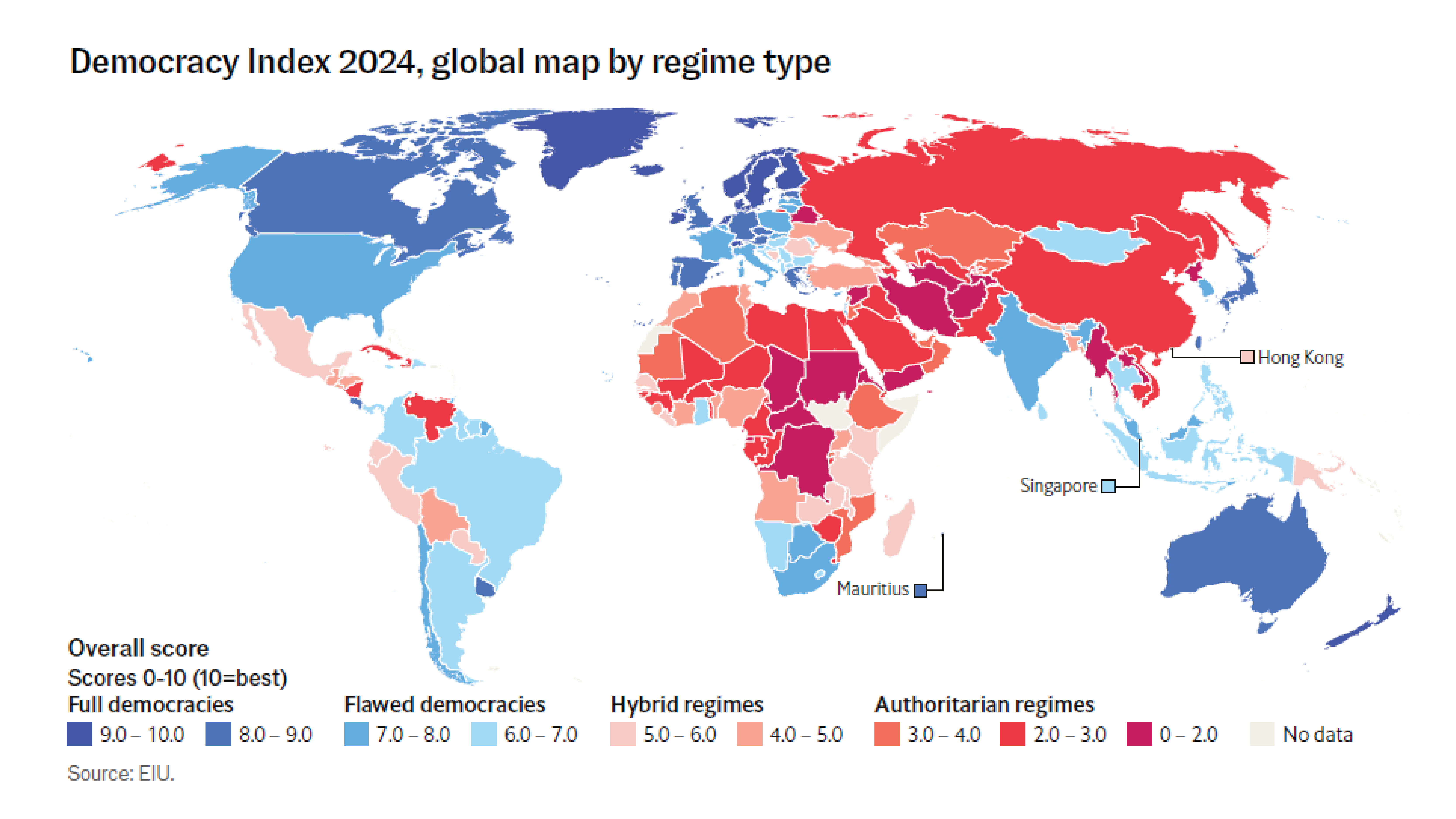
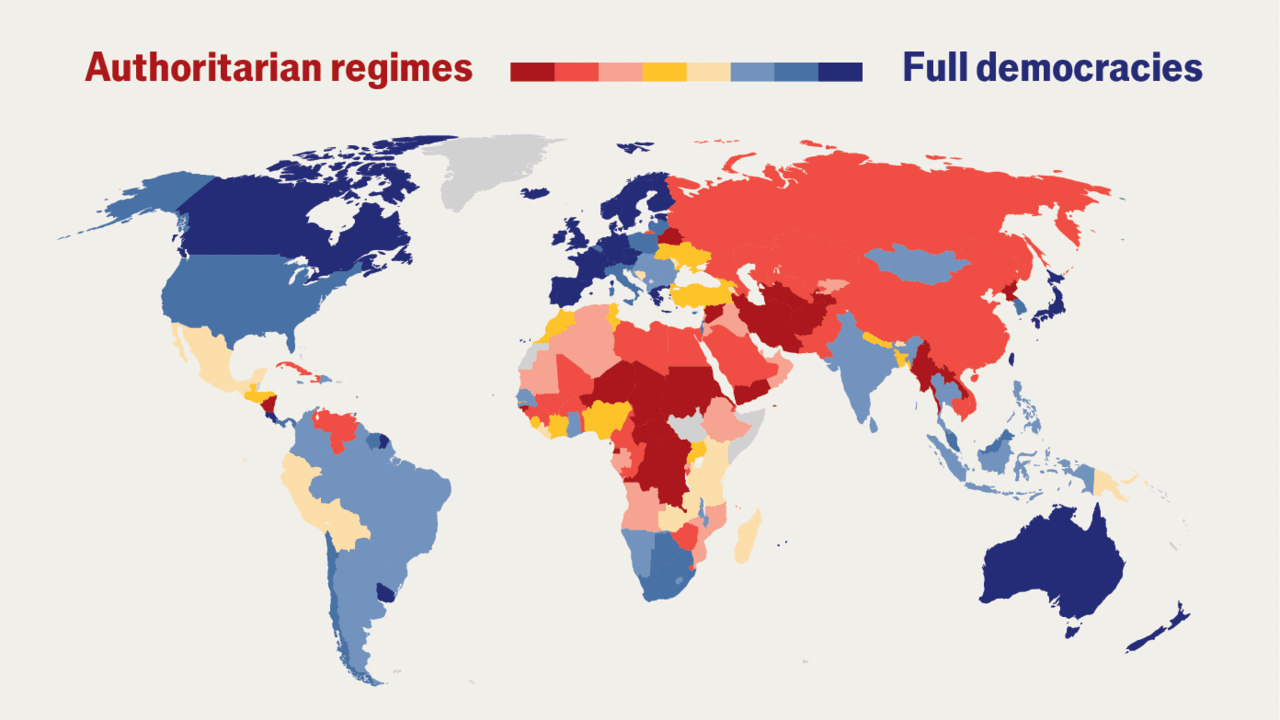
Canada has ranked 14th on the Economist Intelligence Unit’s (EIU) annual Democracy Index 2023, slipping down from 13th in 2023 and 12th in 2022, but remaining one of the few top global energy exporters on the list classified as a “full democracy.”

First published in 2006, the EIU’s index sets out to measure the state of democracy in nearly 200 countries using 60 different indicators across five categories, including: electoral process and pluralism, functioning of government, political participation, political culture, and civil liberties.

While Canada's rank has dropped slightly over the past few years, our country maintains a high score of 8.69 out of a perfect 10. According to the EIU, just 6.6 per cent of the world's population lives in a country considered a “full democracy,” down from 7.8 per cent a year prior.

We should be proud!

Here are the top 15 most democratic nations on the EIU's Democracy Index 2024, along with their corresponding score.

Most Democratic Countries in the World (2024)

#1 – Norway – 9.81/10.00
#2 – New Zealand – 9.61
#3 – Sweden – 9.39
#4 – Iceland – 9.38
#5 – Switzerland – 9.32
#6 – Finland – 9.30
#7 – Denmark – 9.28
#8 – Ireland – 9.19
#9 – Netherlands – 9.00
#10 – Luxembourg – 8.88
#11 – Australia – 8.85
#12 – Taiwan – 8.78
#13 – Germany – 8.73
#14 – Canada – 8.69
#15 – Uruguay – 8.67

Canada Ranks 13th on Democracy Index 2023

Democracy Index 2024: Highlights

Overall, 2024 marked another difficult year for democracy, characterized by rising authoritarianism, failing governance, and widespread voter discontent. These trends underscore significant challenges for the global state of democracy.

Global Democracy Regression: The overall Democracy Index score declined from 5.23 in 2023 to 5.17 in 2024, marking a continued global democratic backsliding. A total of 83 countries showed a decline in their scores compared to only 37 that improved, and the number of democracies decreased by three to 71 globally.

Rise of Authoritarian Regimes: 60 countries, covering 39.2% of the world’s population, now fall under the "authoritarian regime" classification. This number has increased from 52 in 2014, showing the growth and entrenchment of authoritarian rule worldwide.

Regional Declines: Every region except Western Europe and North America experienced a decline in their Democracy Index scores in 2024. The Middle East and North Africa saw the largest drop (-0.11 points), followed by Asia and Australasia (-0.10 points).

Major Election Year: 2024 was the largest election year in history, with over 70 countries holding elections, including eight of the ten most populous nations. However, many elections faced flaws such as ballot rigging, voter intimidation, or outright cancellations.

Regime Changes: Nine countries experienced regime category changes, the highest in years. Estonia, the Czech Republic, and Portugal were upgraded to "full democracies," while France and South Korea were downgraded to "flawed democracies." Bangladesh experienced the most significant deterioration due to political unrest after a rigged election.

Polarisation and Dysfunction: Many advanced and lesser-developed democracies alike suffer from political polarisation, voter disillusionment, and governance dysfunction. For example, South Korea was downgraded to a "flawed democracy" following its political crisis, including a brief declaration of martial law.

Nordics Reign Supreme in Democracy: Nordic countries (Norway, Iceland, Sweden, Finland, and Denmark) continued to dominate the rankings, occupying five of the top seven positions. Norway remained the highest-scoring country globally with a score of 9.81.

Sharp Declines in Civil Liberties and Electoral Processes: Civil liberties and electoral process scores faced significant declines globally. Civil liberties fell by 0.04 points in 2024, continuing its decline post-COVID lockdowns, while electoral processes declined markedly in regions such as Asia, Sub-Saharan Africa, and the Middle East.

Why is Democracy Important?

Stable and transparent governments are built on a strong foundation of civil rights and the rule of law, conducive to the creation and unrestricted operation of private businesses. On the other hand, authoritarian regimes that suppress the rights and liberties of their population tend to have the opposite effect, limiting business opportunities for individuals and enterprises not owned by the state.

While democracy isn't the only factor in determining good economic performance, it is integral in providing individuals and companies with the political stability and business environment required to build a foundation for steady growth and investment over the long term.

Canada's position as a world-class leader in social and governance indicators, as shown in the Democracy Index 2024, indicates the opportunity we have to expand our global market share for critical commodities such as oil, natural gas, and minerals. Canada can – and should – unleash its natural resources onto global markets to help displace supply from less stable producer nations, while continuing to promote democratic values and resource security abroad.

More Canadian resources on global markets is good for Canadian families, global human rights, and global social progress.

Global Resource Demand is Growing

Canada is a leading global producer of a variety of natural resources. We are the:

  • top producer of potash
  • second-largest producer of uranium
  • third-largest producer of hydropower
  • third-largest producer of diamonds
  • fourth-largest producer of gold
  • fourth-largest producer of oil
  • fifth-largest producer of natural gas
  • seventh-largest producer of electricity
  • seventh-largest producer of renewable energy
  • one of the world’s largest producers of softwood lumber
  • a top global agriculture and agri-food producer

The list goes on. We are also the world's eighth-largest biofuel producer, and have the ninth-largest onshore wind power generation capacity.

In 2022, Canada was the world's second-largest electricity exporter, accounting for about 8 per cent of global exports. We generate around 83 per cent of our electricity from sources such as hydro, nuclear, wind and solar, some of which is exported to the United States.

With global demand for everything from oil and gas to renewables to minerals to food projected to grow over the next several years, Canada’s democratically produced resources are an ideal choice for the world. However, we still face some export capacity constraints, which are blocking Canadian energy from reaching global markets.

Canada needs to get to work and build the new pipelines, powerlines, ports, railways, and roads that will enable us to secure our economic independence and future prosperity.

The World Needs More Canadian Resources – Not Less

Most investors today consider a long list of criteria when choosing where to invest their money, including banking infrastructure, economic indicators, fraud and corruption indices, trade relations, and regulatory environments, to name a few.

As the 14th most democratic country on Earth – a supposed prerequisite for a healthy business environment – Canadians need to start asking why so much capital investment and investor confidence has fled our country over the past several years. Canadians also must begin to closely examine why we have difficulty building new natural resource projects like LNG export facilities when there is a clear business case for these projects and other countries are full speed ahead.

It's time for all Canadians to recognize that we are one of the most stable and democratic natural resource producers on Earth, and to understand the immense socio-economic benefits our resource industries, particularly the energy sector, create for our families from coast to coast.

Join Us Today!

Canada is one of the few remaining full democracies with an abundance of natural resources, ranging from minerals and softwood to food and energy. More Canadian resources on global markets is good for our nation's economy and future prosperity.

We invite you to join us online to learn more about Canada's global rankings on Twitter, Instagram and Facebook today!