Expanding Oil Pipeline Export Capacity Could Add $280 Billion to Canada's GDP from 2027-2035: REPORT

Expanding Oil Pipeline Export Capacity Could Add $280 Billion to Canada's GDP from 2027-2035: REPORT

Canadian pipelines make Canada stronger, could add 282 billion to GDP from 2027 to 2035

As Canada looks to build major projects to secure its economic future, new analysis shows that oil pipelines could play a key role in achieving a stronger, more prosperous future for all Canadians. 

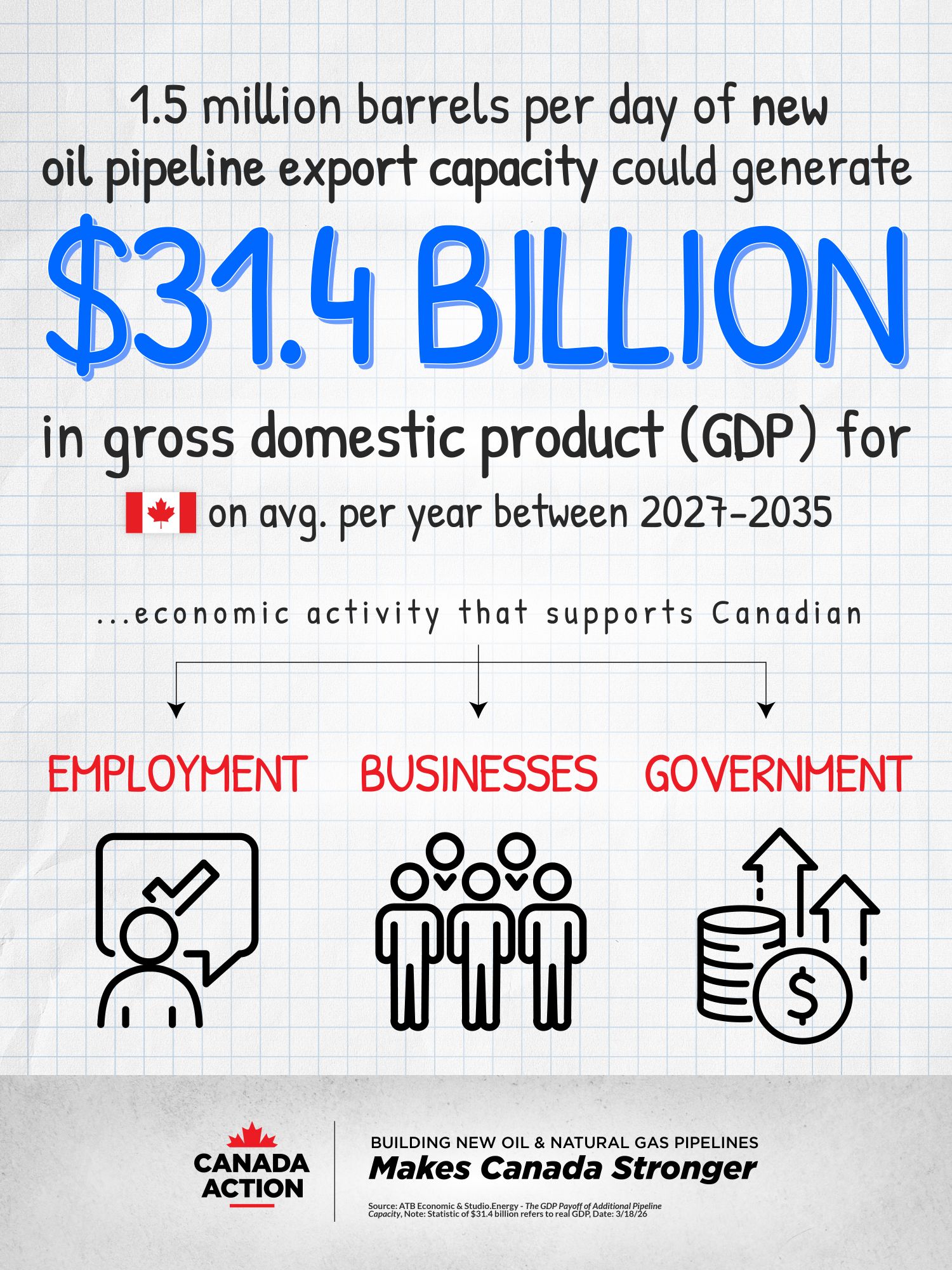
The joint report by ATB Economics and Studio.Energy found that adding 1.5 million barrels per day (MMB/d) of new oil pipeline export capacity — an increase of nearly one-third over current levels — could add an average of $31.4 billion to Canada's real gross domestic product (GDP) each year between 2027 and 2035, totalling more than $282 billion in economic impact. These pipeline projects would also support an estimated 112,000 more jobs in Canada.

At a time when Canadians are deeply concerned about economic competitiveness, trade challenges, and rising living costs, this report delivers a clear message: building new pipelines is an economic imperative. Canada has struggled to grow GDP per capita and productivity levels for more than a decade, and the report's findings suggest that expanding oil export infrastructure offers one of the most direct, achievable paths to reversing that trend. 

The report is the fourth installment in ATB Economics and Studio.Energy's Canada's GDP Series, which argues that GDP is no longer simply a measure of prosperity, but a source of national leverage in an increasingly competitive and coercive global economic environment.
Key Highlights

1.5 million bpd of new oil capacity could generate 31.4 billion per year for Canada from 2027-2035

Economic Impact: Adding 1.5 MMB/d of oil pipeline export capacity could increase Canada's real GDP by an average of $31.4 billion per year between 2027 and 2035

Peak GDP Gain: The single-year peak impact reaches $39.7 billion in 2033, representing a 1.4% increase over the baseline

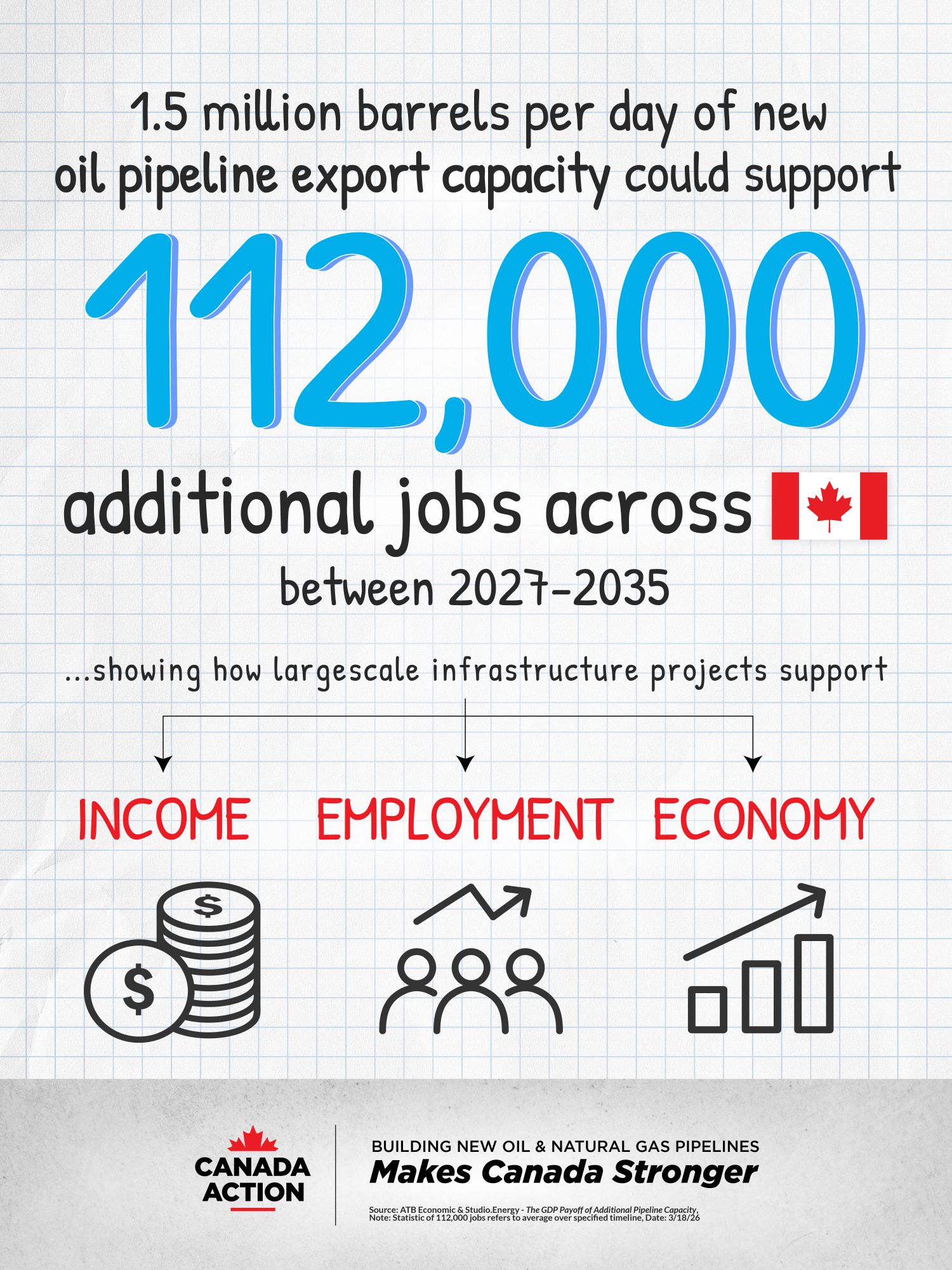
Jobs Created: The buildout is estimated to support an average of 112,000 additional jobs per year across Canada during the same period, peaking at 136,100 jobs

Alberta Impact: Alberta's real GDP could rise by an average of 5.1% relative to the base case – ranging between 2.6% and 6.5% – over the 2027 to 2035 period

British Columbia Impact: B.C.'s real GDP is projected to rise by an average of 0.8%, driven by pipeline construction, marine terminal infrastructure, and export services

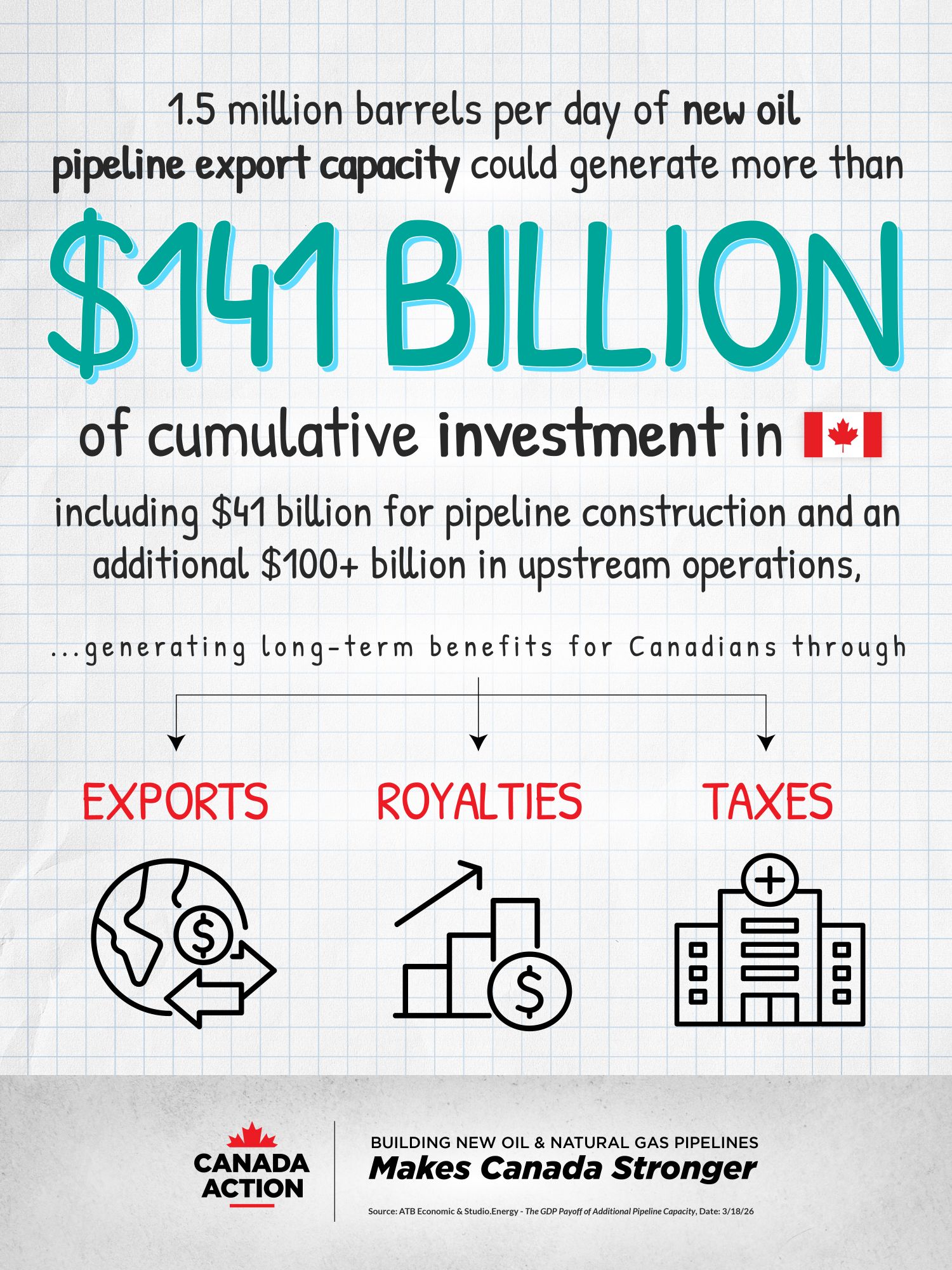
Total Pipeline Investment: Building the required pipeline infrastructure is estimated to require approximately $41 billion in cumulative capital investment

Upstream Investment: Filling that capacity would require an additional $100+ billion in upstream oil production investment, generating long-term returns through export revenues, royalties, and taxes

Per Capita Gains: Critically, the GDP percentage gains would come not from higher population, but from activities that contribute to higher GDP per person, helping to address Canada's longstanding productivity gap

What New Pipelines Mean for Canada

New oil pipelines could support 112,000 more jobs in Canada between 2027-2035

Canada's economic conversation has been dominated in recent years by concerns over low productivity, affordability, and trade vulnerability, particularly in the wake of renewed tariff pressures from the United States. This analysis powerfully reframes the debate: Canada already holds one of the world's most valuable energy commodities, and the country is leaving tens of billions of dollars on the table by failing to build the infrastructure needed to deliver its energy resources to global markets.

The report's modelling – built on a macroeconomic forecasting model containing more than 1,600 equations – found that the economic impacts of expanded pipeline capacity would ripple far beyond the energy sector. Major projects of such scale generate demand across engineering, construction, manufacturing, transportation, equipment, finance, retail, and professional services.

Perhaps most importantly, the report identifies new oil pipelines as a much-needed source of economic growth, separate from the population-driven expansion Canada has seen over the past decade. Canada's GDP has grown in recent years largely due to record immigration, but GDP per capita has performed poorly, ranking near the bottom among OECD countries since 2015.

Pipeline-driven GDP increases, by contrast, come from building productive capacity and expanding exports – precisely the kind of high-quality economic growth that raises wages, sustains government services, and delivers long-term national prosperity.

The report also notes that after construction wraps up and pipelines begin flowing at full capacity, the economic contribution shifts from investment-driven to export-driven, a durable, multi-decade source of income for Canadians and their governments.

Global Oil Demand is Growing

New oil pipelines in Canada could generate more than 141 billion of cumulative investment

A common argument against new oil pipeline infrastructure is that global oil demand will soon peak and decline, leaving new pipelines stranded assets. The ATB Economics and Studio.Energy report confronts this argument directly, dismantling this misleading narrative.

Oil is not simply a transportation fuel. It is a critical input for petrochemicals, plastics, fertilizers, lubricants, aviation, shipping, and heavy industry, end uses which are deeply embedded in global manufacturing and are far less exposed to shifts in energy consumption than passenger vehicles. Global oil demand is expected to remain substantial for decades, driven in large part by rapidly industrializing economies in Asia, the Middle East, Africa, and Latin America.

Canadian heavy crude in particular is well-suited for the new generation of integrated refining and petrochemical complexes emerging across Asia and the Middle East. These facilities are specifically designed to process heavy crude into high-value products. Accessing these markets at scale, however, requires exactly what Canada currently lacks: pipeline export infrastructure with access to tidewater.

In a world where energy security and supply chains have become instruments of statecraft, and where countries actively compete to lock in resource partnerships and reduce dependencies on unstable suppliers, Canada's failure to build adequate pipeline capacity would be both an economic and strategic mistake.

Canada's allies are looking for reliable, like-minded energy suppliers. Canada is positioned to be one of the world's best, but only if it has the infrastructure to deliver.

Canada Is a Reliable Energy Supplier

Building natural resource projects and new trade infrzstructure makes Canada stronger

The bottom line is clear: Canada has a world-class energy resource, a growing global customer base, and an economic imperative to act. Expanding its pipeline network is the key that unlocks it all.

Diversifying Canada's oil export markets is good for every Canadian who benefits from the royalties, taxes, and employment that the energy sector generates from coast to coast. When Canada's oil gets a fair price on the global market, every province benefits.

Join us today to learn more about the transformative economic potential of Canada's energy sector and why building the infrastructure to move our resources to the world is one of the most important actions we can take for the future of our country.

SOURCES:

1 - https://www.atb.com/siteassets/business/special-reports/canadas-gdp-atb-economics-series-with-studio.energy-part-4.pdf