Canada’s Top Agricultural Exports by Country (2024)

Canada’s Top Agricultural Exports by Country (2024)

What are Canada's top agricultural exports

Canada’s agricultural and agri-food industry is an absolute economic powerhouse, contributing $150.8 billion to our gross domestic product (GDP) and supporting approximately 2.26 million jobs nationwide in 2024. It also plays an instrumental role in feeding not only Canadians, but the world [1].

With more than $100 billion of agricultural and seafood exports in 2024, Canada does more than its fair share to ensure a steady, reliable global food supply. Today, we are the ninth-largest exporter of agriculture, agri-food, and seafood worldwide, behind the US (1), Brazil (2), the Netherlands (3), Germany (4), China (5), France (6), Spain (7) and Italy (8), and export more than 50% of our total food production annually [1].

While Canada continues to be a top ten global agricultural and seafood exporter, this role does not come without its challenges. Some of the world’s largest food markets have imposed tariffs on Canadian imports in recent years, while global uncertainty has stifled innovation and development here at home.
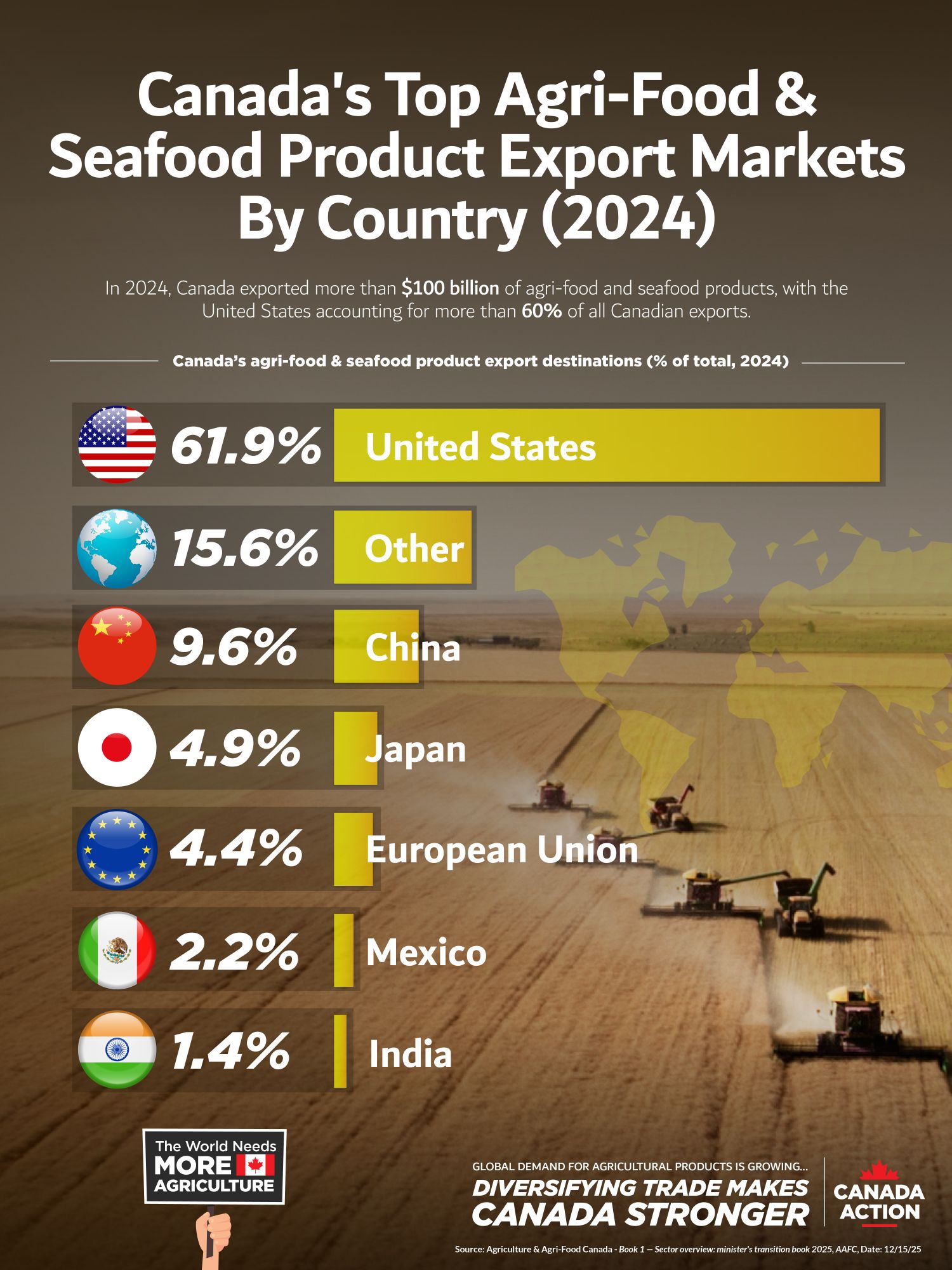

Canada’s Top 10 Agricultural & Seafood Exports By Country (2024)

Canada's top 10 agricultural exports by country (2024)

  • 61.9% - United States
  • 9.6% - China
  • 4.9% - Japan
  • 4.4% - EU 27
  • 2.2% - Mexico
  • 1.4% - India
  • 15.6% - Other

Canadian AG Exports 2024: Highlights

i love agriculture banner 1

(1) Canada was the ninth-largest exporter of agricultural and seafood in the world in 2024 [1]

(2) Canada exported $100.3 billion of agricultural and seafood goods in 2024, up 1.1% year-over-year and 62.7% higher than $61.6 billion in 2015 [1]

(3) Between 2013 and 2024, Canadian exports of agriculture, agri-food, and seafood products increased by 98.9% [1]

(4) Canada exports more than 50% of its total agricultural and seafood production every year [2]

(5) Canada’s top five export markets account for more than 80% of Canadian agri-food and seafood exports to foreign markets in 2024 [1]

(6) Canadian agriculture exports to the U.S. have increased by a compounded annual growth rate of 7.3% since 2015 [1]

(7) Canada’s agriculture and seafood exports in the first two months of 2025 totalled $16.8 billion, up from $15.2 billion year-over-year [1]

(8) Non-durum wheat is Canada’s largest agricultural and seafood export, totalling ~$8.1 billion in 2024 [1]

(9) Canola seed was Canada’s second-largest AG export, at ~$5.9 billion in 2024 [1]

(10) If trends continue, Canada’s agriculture and agri-food exports, including fish and seafood, could grow to an estimated $121.8 billion by 2034 [1]

Canada’s Top 10 Agricultural & Seafood Exports by Commodity (2024)

Canadian agriculture infographics banner

  • Non-durum wheat excl. seed - $8.111 billion
  • Canola seed – $5.943 billion
  • Bread & baked goods - $5.828 billion
  • Canola oil, excl. crude - $3.746 billion
  • Soya beans, excl. seed - $3.34 billion
  • Fresh boneless beef - $3.083 billion
  • Frozen French fries - $2.817 billion
  • Canola meal - $2.695 billion
  • Fresh boneless pork - $2.284 billion
  • Live cattle - $2.224 billion

Export Challenges Faced by Canada’s Agriculture Sector

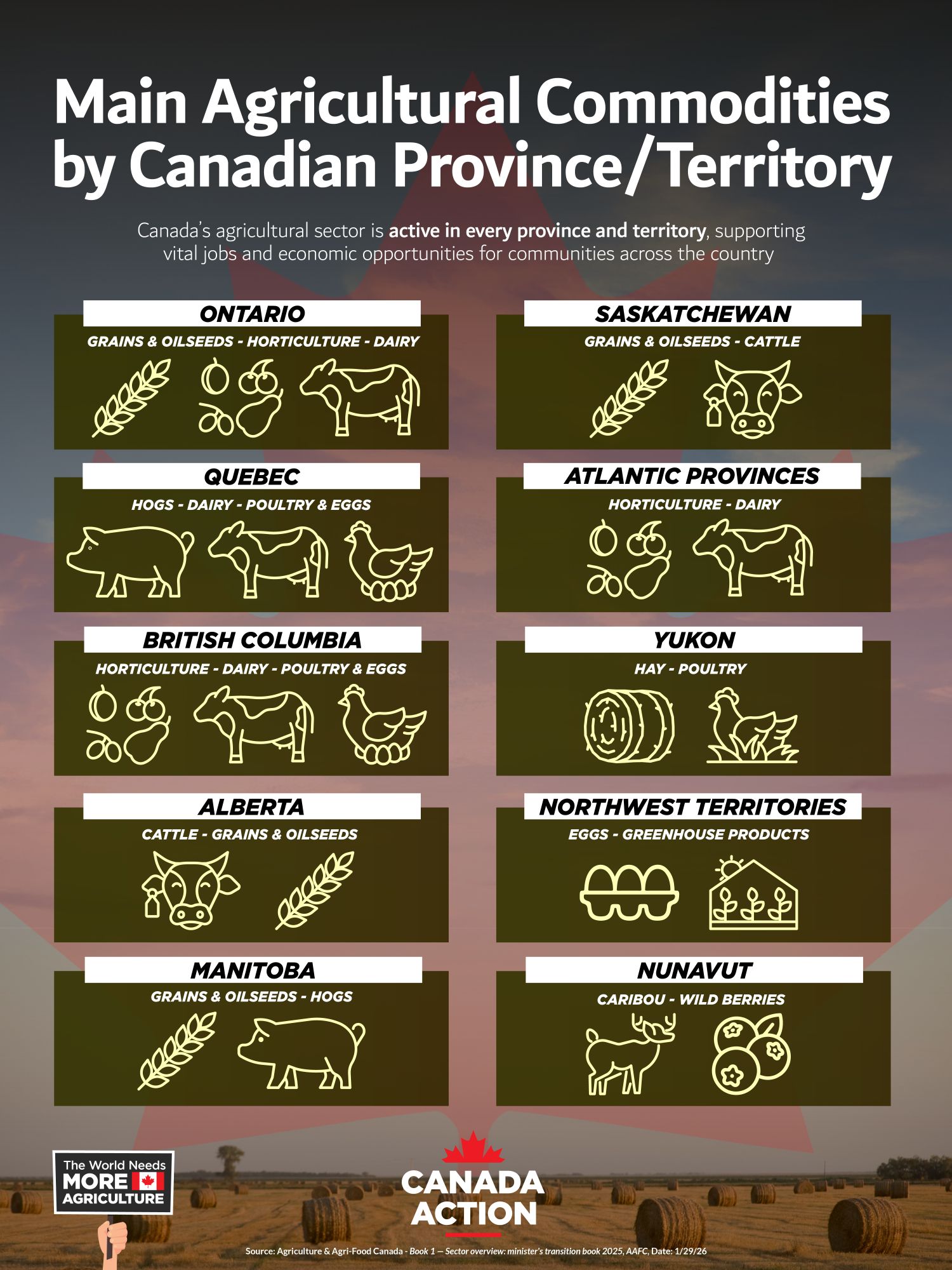
Main agricultural commodity production by Canadian province and territory

Despite recent record-high farm income, Canada’s agricultural sector faces its most fragile trade climate in decades. While global food demand rises, Canada’s position as an exporter has slipped, dropping from a historic top-five ranking in various years throughout the 2000s and 2010s to ninth place in 2024 [1].

Canada’s agricultural food and supply chain must navigate a perfect storm of intensifying global competition while striving to keep pace with competitors aggressively capturing emerging growth markets.

Uncertain Trade Environment

Global trade stability is eroding, creating significant headwinds for Canada's exporters. Analysts project a short-term dip in export values as commodity prices retreat from historical peaks, a trend worsened by rising protectionism [1].

Canadian agricultural producers currently face restrictive tariffs from key partners, such as China and the U.S., which threaten to sever long-standing supply chains. These disruptions are not temporary inconveniences; markets lost today are difficult to regain once foreign buyers establish relationships with new competitors.

Furthermore, the evolving trade policy stance of the U.S. administration has injected unprecedented volatility into the market, complicating long-term planning for Canadian businesses and industries that are heavily reliant on American consumers.

Loss of Confidence

Economic unpredictability is proving as challenging to Canadian exporters as the trade barriers themselves. Empirical evidence suggests that when investors lose faith in the durability of trade agreements, capital investment freezes. This "chill" is already affecting Canada's value-added sectors; major projects, such as new canola-crushing and biofuel plants, have stalled due to prevailing uncertainty [1].

Without a stable investment climate, Canada’s agricultural and aquaculture sectors are having a harder time funding the innovation needed for future growth, risking long-term stagnation in industries that require constant modernization to stay competitive.

The World Needs More Canadian Agriculture!

i love agriculture banner 2

Canada stands at the threshold of a new era in global agriculture. We already possess the essential ingredients for unrivalled success: abundant land and water, a brilliant workforce, and a worldwide reputation for safety and quality. But to truly lead the world in food production, we must look forward with ambition.

By committing to modernize our critical trade infrastructure—upgrading our ports, expanding our railways, improving our roads, reducing regulatory barriers, building cutting-edge processing facilities, and diversifying our trade—we will do more than just keep up; we will set the global pace.

It's time for action! Join us today!

SOURCES:

1 - https://agriculture.canada.ca/en/department/transparency/briefing-documents/aafc-transition-books/book-1-sector-overview-ministers-transition-book-2025-aafc

2 - https://www.fcc-fac.ca/en/knowledge/economics/understanding-trade-overview