Canada has long relied on the U.S. as its number one trading partner, with more than 75% of Canadian exports going south of the border in 2024. This tight integration has created immense benefits for workers and businesses in both Canada and the U.S. However, recent trade challenges between our two nations have also highlighted a glaring weakness in the Canadian economy – our over-reliance on a single trading partner.
As a nation where one-third of national revenue and 1 in 5 jobs are supported by exports [1][2], it has become clear that Canada’s prosperity depends significantly on trade with the United States. Even small policy shifts in Washington can have outsized consequences for Canadian jobs, investment, and government revenues here at home. Canada and the U.S. are the closest allies, and we should work together wherever we can. But now, with the economic fallout from U.S. tariffs seen across the country, Canadians realize we need other trade partners to secure our future.
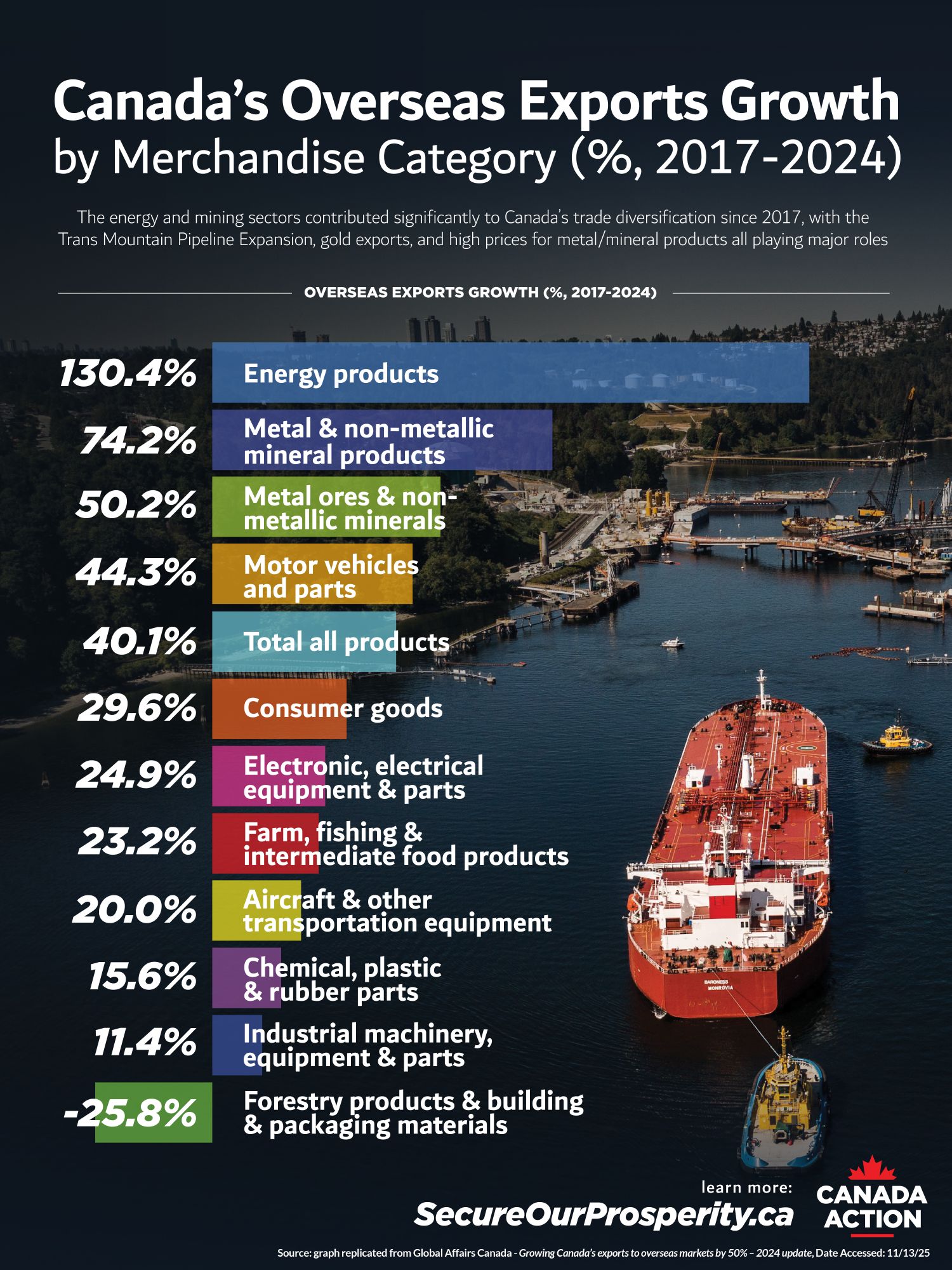
As a result, diversifying our overseas exports has become a critical national goal. Since 2017, Canada has made considerable progress in expanding exports to markets beyond the U.S., and some sectors, such as mining and energy, have been key drivers. But more can be done by supporting the development of resources and new trade infrastructure.
Below, we take a look at how Canada has fared since 2017 on its trade diversification efforts, after setting a goal in 2018 to increase overseas (non-U.S.) exports by 50% through 2025 [3]. Also see: