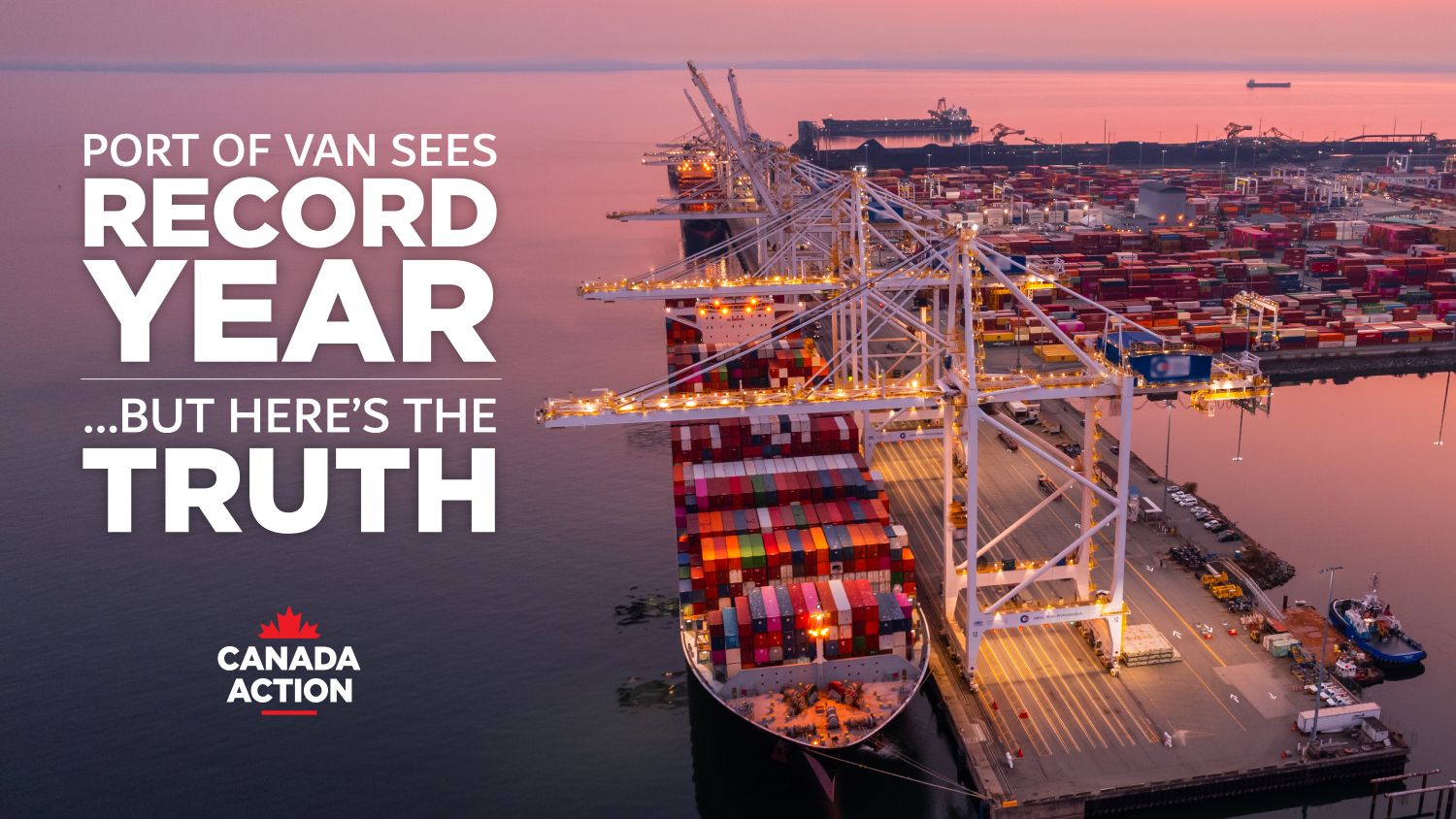
Port of Vancouver Sees Record Cargo Volumes – But New Infrastructure a Must

Port of Vancouver Sees Record Cargo Volumes – But New Infrastructure a Must

Port of Vancouver Reaches Record Cargo Volumes But Here is the Truth cover

3 Key Takeaways

  • Record Growth: Vancouver's port moved 170.4 million tonnes (MMT) of cargo in 2025 with commodities leading the way, exporting 39.9 MMT of coal, 30.6 MMT of petroleum products, 30.03 MMT of bulk grain, and 14 MMT of fertilizer
  • Crumbling Infrastructure: A 1969-era rail bridge at the port could single-handedly halt billions of dollars in Canadian trade, on full display earlier this year.
  • Build Now: Canada must invest urgently in our ports, rail and roads to secure our economic future.

---------------------

Canada's Pacific gateway just had a record-setting moment that all Canadians can celebrate.

The Port of Vancouver – Canada's largest and busiest seaport – recorded a historic eight per cent increase in cargo volumes in 2025, moving 170.4 million tonnes [1]. The huge milestone was driven by surging overseas demand for Canadian goods, as shippers and exporters have increasingly sought to secure customers abroad amid persistent trade challenges with the U.S. [2].

The numbers tell a remarkable story, particularly about the significant impact that natural resources have on the Canadian economy.


Grain, crude oil and potash all reached record levels last year. These aren't marginal gains; they represent some of the largest year-over-year jumps in the port's history.

A bumper crop season saw bulk grain exports reach a new high of 30.3 million metric tonnes (MMT) in 2025, riding on the back of strong wheat exports, up 20% year-over-year to reach a record of 15.9 MMT [1]. Wheat grown in Western Canada was delivered to 35 countries last year through the port, from the Indo-Pacific to the Middle East [1].

Crude oil exports nearly doubled, fuelled by the Trans Mountain Expansion Project [1], with the pipeline completing its first full year of operations in 2025. For the first time, more Canadian oil is flowing at scale to energy-hungry customers in China and South Korea. Crude oil is now one of the largest single export commodities moving through the Port of Vancouver and is responsible for a significant share of Canada’s trade diversification to global buyers in recent years.

Fertilizer cargoes told an equally impressive story. Potash exports surged 28% compared to 2024, helping push total potash volumes to a new record of 10.5 MMT and surpassing the previous record set in 2020 [1]. Combined with a 5% rise in sulphur shipments, overall fertilizer exports through the port climbed 21% in 2025, reaching customers in Brazil, China, Indonesia, and other markets worldwide [1].

Vancouver also continued to be a major exporter of metallurgical coal (used in steel production), sending 39.9 MMT to buyers abroad – the largest resource export by volume from the port in 2025 [1].

Strong Numbers, But Serious Work Ahead

Canada needs a stronger economy - banner

But here’s the honest truth. Despite record numbers, the Port of Vancouver is among the most inefficient globally.

Late last year, Federal Transport Minister Steven MacKinnon acknowledged as much during a visit to the port, saying plainly: “Canada has a lot of geography, so we need to make sure that our transportation policies, infrastructure and our management of supply chains is the best in the world.”

“I don’t think it currently is,” he continued.

And he’s right. According to the latest Container Port Performance Index (CPPI), the Port of Vancouver ranks an abysmal 398 out of 403 worldwide.

The challenges faced by the port are well-documented and numerous.

Labour disputes, including a 13-day strike in 2023 and a lockout in the fall of 2024, have rattled shippers and damaged confidence.

The port's North Shore terminals are served by a single-rail bridge, the Second Narrows, creating a major chokepoint for the entire port. This massive vulnerability was on stark display in early 2026, when this rail bridge jammed, bringing tanker traffic in the Burrard Inlet to a halt [4]. For days, the bridge – which opened in 1969 – threatened to cut off access to Canada’s largest port, potentially disrupting billions of dollars in trade [4].

The port’s low efficiency is well known, with high vessel wait times, inadequate capacity to handle increasing trade volumes, and constrained terminal space and inland transportation bottlenecks.

With all the recent talk about Canada as a reliable supplier of critical commodities that pass through the Port of Vancouver daily, it’s clear we need to act now to fix these problems. These are not abstract; they have real consequences that could worsen if not addressed immediately.

Saskatchewan Potash Producer Builds Port in U.S.

Building Ports Strengthens Canada

A great example of what we speak of is that one of the world’s largest potash producers, based in Saskatchewan, has chosen to build a new export terminal at the Port of Longview, Washington, rather than in British Columbia. The company cited lower rail costs, reduced construction expenses, and a more favourable regulatory environment south of the border as the deciding factors [5].

Stuart Smyth, a professor at the University of Saskatchewan, put it bluntly in an interview late last year with the CBC [6]: “To put a billion-dollar investment in place is going to require rail capacity improvements, and by the sounds of what [the proponent] is saying, things are easier to get done in the United States than they are in Canada.”

We have the resources. We have the demand. But we are sending business – and jobs – across the border because we haven't built the infrastructure our exporters need.

The problems currently faced by the Port of Vancouver should stop every Canadian in their tracks. It is an immediate barrier to a stronger and more prosperous future here at home. We’re an export-based economy, relying heavily on our ports to ship goods in and out of the country.

Canada Needs to Fix Port Infrastructure Now – Not Tomorrow

The World Needs More Canada - Banner Snip

If Canada is truly to double our non-U.S. exports, as Prime Minister Mark Carney has said, then more needs to be done urgently to fix issues with ageing port and railway infrastructure. A single mechanical failure on a bridge built in the late 1960s should not be able to bring Canada's largest port, which handles $350 billion in trade, to its knees.

These facilities play a critical role in shipping Canadian-made products worldwide while also importing a variety of goods that our families, businesses, and industries rely on. Ensuring Canada’s ports are optimized to reduce bottlenecks, maximize efficiency, and handle increasing cargo volumes in both directions should be of the utmost importance.

Returning to Minister MacKinnon, he was direct about what doubling Canada’s international exports requires [3]: "We cannot plausibly do that without increased port capacity on the West Coast. Vancouver is going to be central to that."

It's clear we need action.

This is exactly the mission behind TimeForAction.ca — a Canada Action initiative calling on governments across the country to clear the path for the nation-building infrastructure Canada urgently needs, including pipelines, power plants, transmission lines, ports, railways, and roads. These are not just construction projects. They are the arteries of a thriving, competitive economy. Without them, Canada's resource wealth sits in the ground or gets shipped out through someone else's terminal.

Potential without infrastructure is just a missed opportunity.

Let’s Build Canada's Ports

Canada Action - blog banner supporter banner

The record cargo at the Port of Vancouver is great news and should be celebrated. But underlying the headlines are critical problems with ageing infrastructure, outdated regulations, and layers of red tape that encourage capital to flee to other, more favourable jurisdictions and investors to look the other way.

For the Port of Vancouver specifically, we need to expand its infrastructure. We need to build the Roberts Bank expansion on time. We need to fix the rail bottlenecks and invest in hinterland connectivity. We need to streamline the cruddy regulations that are sending Canadian investment south of the border. And we need to make the port  – and all others across the country – the world-class gateway it is fully capable of becoming.

Canada has everything it takes to lead. Let's build the infrastructure to match our ambition and make sure the next cargo record is even bigger.

The world wants what Canada has. It's time to deliver.

SOURCES:

1 - https://www.portvancouver.com/article/port-vancouver-moves-record-cargo-2025-delivering-more-what-canadians-make-mine-harvest-and

2 - https://boereport.com/2026/03/09/overseas-trade-propels-port-of-vancouver-to-record-cargo-volumes/

3 - https://vancouversun.com/news/federal-transport-minister-challenges-port-of-vancouver-bottom-world-rankings

4 - https://financialpost.com/opinion/opinion-users-need-more-say-about-vancouvers-rail-bridges

5 - https://www.mining.com/potash-political-pushback-canada-counters-nutriens-cross-border-plans/

6 - https://www.cbc.ca/lite/story/9.6992424